


Presented by Gates Foundation
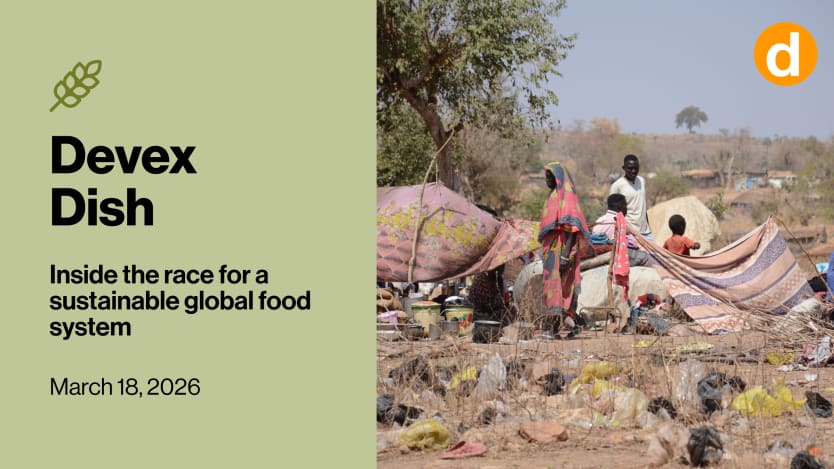
The global food system is in trouble. Nearly three weeks into the U.S.-Israeli war against Iran, the ripple effects are being felt far beyond the battlefield.
While most media coverage has focused on oil and energy security, the effects on the world’s food supply are already being felt. The near-total closure of the Strait of Hormuz — a critical choke point for the global oil supply — is pushing up global energy prices, which in turn jacks up fertilizer and food prices. In the short term, that hurts import-dependent countries — meaning Africa, Asia, the Middle East, and Latin America are most at risk — but it has long-term effects, too. Fertilizer shortages and higher energy prices threaten crop yields, meaning farmers could produce less food in the coming months.
Humanitarian agencies are already struggling to absorb the higher operating costs. “When fuel prices increase, it becomes more expensive to transport food, deliver water, and move humanitarian supplies to the communities who need them most. In practical terms, that means a single intervention costs more,” Melaku Yirga, Mercy Corps’ vice president for Africa, tells my colleague Ayenat Mersie.
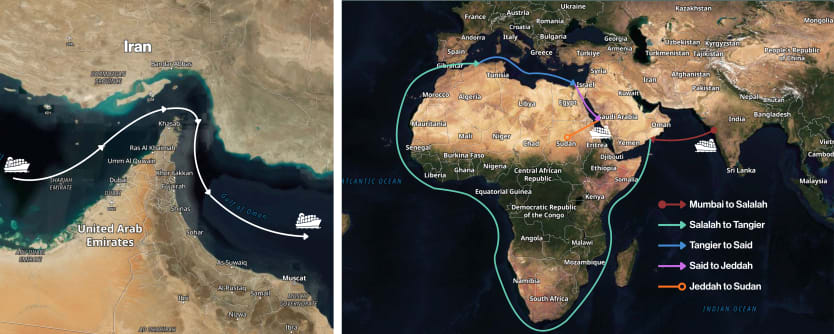
Shipping detours to avoid the Strait of Hormuz are complex and costly, and out of caution, vessels are avoiding the Red Sea, too. That causes problems for operations such as the World Food Programme’s work in Sudan — its biggest humanitarian project, where more than 21 million people currently don’t have enough to eat — which uses the Red Sea as a shipping route for grain from India. Now, vessels are taking much longer routes around Africa — a journey some 9,000 kilometers longer than usual, much slower, and much more expensive. “So we've been facing emergency surcharges as a result of the situation,” says Jean-Martin Bauer, WFP’s director of food security and nutrition analysis. “There’s also more risk insurance — that's between $2,000 and $4,000 per container.”
WFP’s latest hunger estimates are sobering: Almost 45 million more people could be pushed into acute hunger if the conflict doesn’t end by midyear — adding to the 318 million people worldwide who are already food-insecure. Those are record levels of food insecurity. WFP and other experts view the situation similarly to the start of Russia’s war in Ukraine in 2022, which triggered a fertilizer and cost-of-living crisis and forced 349 million people into hunger. “While in 2026 the conflict involves a global energy hub and not a breadbasket region, the potential impact is similar because energy and food markets are tightly correlated,” WFP notes.
When it comes to the war’s implications for agrifood systems more broadly, it’s worth reading the Food and Agriculture Organization’s comprehensive analysis. The disruptions for fertilizer alone could be massive, with at least 30% of the world’s fertilizers moving through the Strait of Hormuz. Iran, Qatar, Saudi Arabia, and Oman are among the world’s leading exporters of nitrogen fertilizers, including urea and ammonia. And FAO points out that unlike oil, there is no internationally coordinated strategic reserve for nitrogen fertilizer, making supply disruptions harder to manage.
As it stands, no country can withstand the shocks to energy, fertilizer, and food systems on its own. Independent research from Economist Impact’s Resilient Food Systems Index — which measures food affordability, availability, quality and safety, and responsiveness to climate risk in 60 countries — shows that countries score an average of barely 64 out of 100 on overall resilience. Seventy percent of the world’s food is produced by just 15 countries — yet alarmingly, even those nations score just above average for resilience, meaning they are exposed to shocks that can easily ripple through the entire system.
The Iran war is a powerful reminder that our interconnected systems of international trade — while miracles of technology and globalization — are fragile and subject to the whims of geopolitics. The domino effects of a crisis reach well beyond the borders of any one country.
So what can be done to stabilize energy and food markets, just in case global leaders decide to keep starting wars? In the short term, FAO and others are calling for alternative trade routes, support for import-dependent countries, and financial assistance for farmers in order to protect supply chains and food security. In the medium term, FAO notes, countries must prioritize diversifying their import sources. And going forward, they should boost domestic production of food crops, sustainable fertilizer, and renewable energy so that they’re more protected from global headwinds.
It should go without saying that ending the war would make a big difference, too.
Read: Beyond the battlefield — the global ripple effects of the Iran war
Don’t miss this opinion from 2023: We must build food system resilience before the next crisis
No time like the present
“We are facing a perfect storm of climate shocks, water stress, land degradation, biodiversity loss, and volatile food prices. Indeed, this could be more exacerbated by the conflict in the Middle East, which drives up energy costs, fertilizer shortages.”
— Masato Kanda, president, Asian Development BankThe Iran war feels ever present at the Asian Development Bank’s Asia and the Pacific Food Systems Forum, where government leaders have joined food and nutrition experts at the bank’s headquarters in Manila, Philippines, to discuss how to build more sustainable and resilient food systems. The region is home to more than half of the world’s population — and almost 40% of the world’s undernourished people.
Crises such as this one reinforce the need for countries to diversify what they produce and where food is grown, said Lawrence Haddad, executive director of the Global Alliance for Improved Nutrition. And while those undertakings are best done in peaceful times, there’s no time like the present to start.
“There’s a saying that the best time to plant a tree is 30 years ago. The next best time is today,” Haddad told Devex Senior Reporter Jenny Lei Ravelo at the forum. “So … we can’t lament the fact that we haven’t done this. We need to do it now. There will be future crises. Climate crises are not going away.”
Haddad joined other experts on the ADB stage yesterday to discuss transforming food systems despite scarce resources. In a moment of levity, the headshot projected on the wall above Haddad’s name was that of Michael Kremer, the American economist who won the Nobel Prize in economic sciences and who’d spoken earlier that day. Haddad, a World Food Prize laureate, took it in stride: “I was thinking maybe it’s a chance to win a Nobel Prize.”
Absent from the gathering is WFP Executive Director Cindy McCain, who had been scheduled to attend and speak alongside FAO Director-General Qu Dongyu. McCain recently announced she was stepping down from her WFP post, citing health concerns following a mild stroke in October.
Key to the forum’s agenda is how the bank should spend the $40 billion it has allocated for food systems transformation by 2030. ADB has already disbursed $14 billion, which has gone to nutrition assistance in emergency contexts such as Afghanistan, nature-based solutions such as the restoration of wetlands, and the creation of shared data platforms, ADB’s Qingfeng Zhang tells Devex contributor Rebecca Root.
To figure out how to target the rest, ADB has partnered with WFP, the United Nations’ Scaling Up Nutrition movement, Nutrition International, and others — with a goal of reaching 190 million smallholder farmers by 2030. Manoj Kumar, the Asia regional director at Nutrition International, notes that ADB must still do internal work “in terms of building a more common narrative within ADB and common buy-in for nutrition.”
“It will take longer time and many battles to be won within ADB and outside ADB for this $40 billion to really be put into practice,” he says. “We have seen some feasible movement and momentum, but we are yet to see some of the larger work.”
Read: ADB gets moving on its $40B commitment to food systems
Background: How ADB plans to invest $40B in food systems by 2030 (Pro)
See also: Is ADB still Asia and the Pacific’s ‘climate bank’?
+ Unlock the power of Devex Pro with a 15-day free trial. Discover the expert analyses and wealth of knowledge that drive global development. Check out all the exclusive content available to Pro members.
Water wars
Bringing home the bacon
Your next job?
Director, Corporate Engagement
Sustainable Agriculture Network
Worldwide (remote)
You can’t have food security without water security — and yet water is absent from many conversations about food systems. That’s the message from Mark Smith, director-general of the International Water Management Institute, ahead of World Water Day, which is Sunday.
“Only by recognizing that water risks propagate through every component of food systems can governments plan, invest, or design policies to manage future water risks in food systems,” he writes in an opinion piece for Devex. “Water management is the foundation of food security and we must prioritize water resilience.”
Read the opinion: Water security failures risk hunger for billions. Countries must prepare
See also: World Bank outlines ways to secure fresh water for a livable planet
Chew on this
Africa’s richest man, Aliko Dangote, has signed a $4.2 billion, 25-year natural gas supply deal with a Chinese firm to power East Africa’s largest fertilizer complex. [Business Insider Africa]
What’s the future of the U.N.? Experts say its reform efforts could cause it to lose relevance. [Devex Pro]
Ethiopian authorities won’t take responsibility for starving displaced people in Tigray despite video evidence. [The New Humanitarian]
Bugs were supposed to be the future of food. Now the insect farming industry is collapsing. [Vox]
Jenny Lei Ravelo and Ayenat Mersie contributed to this edition of Devex Dish.
About the author

Tania Karas@TaniaKaras
Tania Karas is a Senior Editor at Devex, where she edits coverage on global development and humanitarian aid in the Americas. Previously, she managed the digital team for The World, where she oversaw content production for the website, podcast, newsletter, and social media platforms. Tania also spent three years as a foreign correspondent in Greece, Turkey, and Lebanon, covering the Syrian refugee crisis and European politics. She started her career as a staff reporter for the New York Law Journal, covering immigration and access to justice.
Search for articles


Most Read
- 1
- 2
- 3
- 4
- 5