
Devex Newswire: NGOs brace for a long fight with Trump administration




Presented by RADIAN

NGOs may face a “permanent shift” in relations with Washington as the Trump administration ramps up pressure on the sector. Experts warn that waiting for the next election isn’t a strategy.
Also in today’s edition: We look at the USAID shutdown shambles, emergency groups in Sudan, and a land dispute stalls a disability housing project in Sierra Leone.
🇺🇳 Can the United Nations survive the Trump administration? On Tuesday, March 10, we’ll dig into whether the U.N. can reinvent itself to meet this moment of crisis and the questions around who will be the next secretary-general. Register now to join this Devex Pro Briefing.
Under pressure
NGOs may need to buckle up for the long haul — that was the message from a recent Devex Pro Briefing. Panelists warned that the Trump administration’s pressure on the sector — from funding cuts to political attacks — could signal a “permanent shift” in how civil society interacts with Washington.
Some organizations are wondering whether the safest move is to keep their heads down and wait for the next election. But that’s a risky bet, said Tatyana Margolin, cofounder of anti-authoritarian group STROIKA and former regional director for Open Society Foundations’ Eurasia program.
“I don’t think we have a single lesson from history of folks just sitting on the sidelines of rising authoritarianism and it dissipating on its own,” she said. “This is a marathon. This is not a sprint. This may be a very long-term battle. … I think we should absolutely not be waiting for and expecting things to get better without our pushback.”
Others pointed to cautionary tales, writes Jessica Abrahams for Devex. Veronika Móra, director of the Okotars Foundation in Hungary, recalled how many initially assumed Viktor Orbán’s government wouldn’t cross certain limits. But “they crossed each and every red line,” Móra said, warning that “continuous deterioration is part of these systems.” Even when governments change, she noted, the damage can linger — just look at Poland’s struggle to rebuild institutions after democratic backsliding.
The bottom line: NGOs may need to shift from quiet program delivery to something closer to political endurance sport. Kay Guinane, the former director of the Charity & Security Network, said groups should invest more in coalition-building, investigations, and other “proactive ways of pushing back.” Or as she put it: “These are things we need to be putting resources into. It needs to be part of our core work, not something that we just do in response to emergencies.”
Read: Get ready to push back against the government, US NGOs told (Pro)
ICYMI: NGOs say they’re under attack from Trump — and are ready to fight back (Pro)
🗝️ Not yet gone Pro? Starting a 15-day free trial today gives you access to all our exclusive news and expert analyses digging into the development sector, including regular briefings on funding opportunities and philanthropy trends, industry insights on AI implementation trends, and a trove of behind-the-scenes knowledge you won’t get anywhere else.
USAID closeout chaos
The long goodbye at USAID is getting messy. Inside the agency’s so-called legacy unit — the tiny team left to close out the remains of what was once a 10,000-person aid powerhouse — morale is grim. Check out my colleague Michael Igoe’s special newsletter for more on this.
A few dozen career officials are now trying to untangle thousands of terminated awards and hundreds of millions of dollars owed to former partners, all while operating under what insiders describe as toxic mistrust, impossible deadlines, and constantly shifting instructions from political appointees at the White House Office of Management and Budget.
The process was supposed to be done by tomorrow. That deadline has quietly slipped, with remaining staff now extended through Sept. 30. In the meantime, insiders say the process has ground down even the officials who stayed out of a sense of duty to partners they hoped to get paid. “Their intention is not to pay,” says a former USAID official who was involved in the closeout process. “They're pushing back against everything.”
Even routine closeout tasks can take months — and in this case, they’re being done without the country mission staff who knew the projects best. Meanwhile, contractors say they haven’t been paid termination costs since September, leaving some to rely on loans while they wait. One CEO sums up the mood: “They think that we are part of this woke den of thieves who somehow have been getting fat on foreign assistance.”
Read: Inside the USAID closeout mess (Pro)
🎧 Listen: For the latest episode of our podcast series, This Week in Global Development, Michael joins colleagues Rumbi Chakamba and Jesse Chase-Lubitz to further dissect the challenges surrounding the closeout process as well as the takeaways from the European Investment Bank annual meetings.
Bouncing back
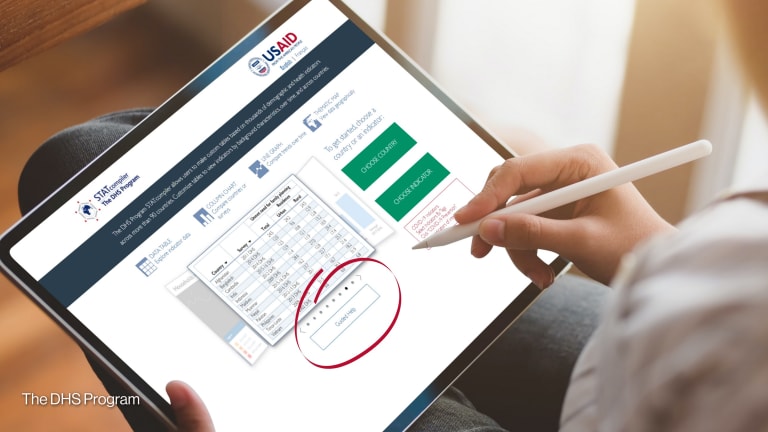
For 40 years, the Demographic and Health Surveys, or DHS, program has quietly powered global health policy — the data behind child mortality rates, HIV prevalence, and dozens of SDG indicators. Then Washington pulled the plug, writes Senior Reporter Sara Jerving.
When the Trump administration scrapped a $236.8 million USAID contract with American global technology company, ICF, more than two dozen active surveys stalled and the future of one of the world’s most trusted health data pipelines was suddenly in limbo.
“Over such a long period of providing high-quality, reliable data it became a brand that has such strong support for being as close to the truth as we can get with statistics,” says Madeleine Short Fabic, senior strategy and technical adviser with the global health and development team at ICF.
The scramble that followed forced a rethink. The Gates Foundation stepped in with $39 million. Other donors are helping. ICF is trimming costs, automating systems, and pushing for a broader funding base so DHS is never again dependent on a single backer.
It also exposed a blind spot: even the DHS archive wasn’t insulated from U.S. instability.
“The U.S. government had been such a steadfast supporter for so long, and the repository had been stable for so long, that I think the idea of instability there was not very well surfaced before 2025,” Short Fabic says.
Sixteen surveys are now moving forward. ICF is reaching out directly to governments, reassuring them the program is still standing — and evolving.
“There has been a narrative in 2025 of: ‘What is the future without the DHS program?’ And I think we have this period of stability to really outline a future that matches with the needs,” Short Fabic says. “People want the DHS program in the future.”
Read: Demographic and Health Surveys reemerge with Gates funds after Trump cut (Pro)
Background: Critical global surveys fall casualty to US foreign aid gutting
🩺 Get the latest inside reporting on trending global health news by signing up for Devex CheckUp, a free, weekly newsletter.
Sudan’s volunteer lifeline
Sudan’s volunteer-run Emergency Response Rooms are quietly sustaining communities through one of the world’s most brutal and overlooked wars. What began as improvised neighborhood committees has grown into a nationwide mutual-aid network running community kitchens, providing basic health care, evacuating civilians, and repairing water systems as the state collapses and international access shrinks.
In their opinion piece for Devex, Sara Pantuliano, chief executive of ODI Global, and Andrea Tracy, executive director of Proximity2Humanity, say these more than 26,000 volunteers are showing what a radically different humanitarian model can look like — one where crisis-affected people lead the response themselves. As one volunteer, Asim, describes from South Kordofan: “People wake up each morning not knowing if they’ll be able to find food or clean water that day.”
Pantuliano and Tracy argue the networks aren’t just filling gaps left by international agencies — “in many places they are the system.” The real test now, they say, is whether donors are willing to shift power and funding to the local responders already delivering aid “at scale, under fire, and with extraordinary accountability.”
Opinion: Sudan’s emergency groups are the future of humanitarian aid, not a stopgap
Land row turns ugly
A disability housing project in Sierra Leone backed by the United Nations Development Programme has hit a messy snag after police allegedly demolished part of a local NGO’s compound and detained its finance director amid a bitter land dispute.
Construction is now paused while the government and Lifeline Nehemiah Projects, or LNP, battle over who actually owns the site, writes Susannah Birkwood for Devex. The NGO says it bought the land in 2020. Officials insist the land has belonged to the Ministry of Social Welfare since 1964 and that the group were merely “tenants.”
LNP Finance Director Mohamed Turay was held for six days and charged with incitement and obstruction of police duty — something the NGO strongly disputes. Sierra Leonean Information Minister Chernor Bah tells Susannah that “due process was followed.”
The fight is now drawing international scrutiny. U.N. special rapporteur Mary Lawlor warned on social media the charges against Turay and the NGO’s executive director appear “baseless & should be dismissed.” Meanwhile, the courts — and UNDP — are still sorting out who actually owns the land.
Read: UNDP-backed disability project becomes flash point in Sierra Leone
In other news
Despite U.S. opposition, Vanuatu is advancing a revised U.N. resolution that calls for the implementation of a landmark International Court of Justice climate ruling and is set for a vote later this month. [The Guardian]
Angola has won World Bank and Multilateral Investment Guarantee Agency guarantees for a $400 million debt-for-education swap. [Reuters]
Mission 300, led by the World Bank and the African Development Bank, has received over $50 billion in commitments for its plan to connect 300 million people in Africa to electricity by 2030. [Bloomberg]
Portugal has been fined €10 million ($11.6 million) by the EU Court of Justice and faces daily penalties for failing to properly protect dozens of designated natural habitats under EU environmental law. [The Guardian]
Sign up to Newswire for an inside look at the biggest stories in global development.
About the author

Helen Murphy
Helen is an award-winning journalist and Senior Editor at Devex, where she edits coverage on global development in the Americas. Based in Colombia, she previously covered war, politics, financial markets, and general news for Reuters, where she headed the bureau, and for Bloomberg in Colombia and Argentina, where she witnessed the financial meltdown. She started her career in London as a reporter for Euromoney Publications before moving to Hong Kong to work for a daily newspaper.
Search for articles


Most Read
- 1
- 2
- 3
- 4
- 5