


Presented by The Rockefeller Foundation

In a bid to deepen international ties and counter pressure from China, Taipei is planning an international NGO hub. But INGOs are weighing incentives, red tape, and geopolitical risk.
Also in today’s edition: We give you the lowdown on “zombie funds,” and a rundown of why U.S. states are cozying up to WHO.
+ Who pays for health in Africa when aid declines? Join us on Feb. 20 for a Devex Pro Briefing with Dr. Mohamed Yakub Janabi, WHO’s regional director for Africa. We’ll discuss the priorities for this critical moment and the future of health in the region. Save your spot now.
Taipei personality
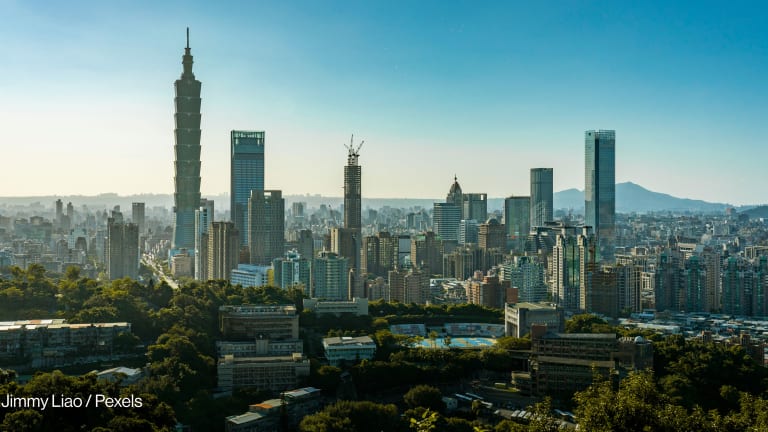
Taiwan wants to turn civil society into soft power. Its Ministry of Foreign Affairs is planning an international NGO center in Taipei — complete with potential rent subsidies, easier office setup, and a bilingual support platform — as part of what it calls “NGO diplomacy,” even as pressure from Beijing mounts.
“One of the major motivations probably would be to increase the positive role of Taiwan in the region, and therefore hopefully strengthen the support of the region for Taiwan’s position and … buttress a little bit against the pressure from China,” says Robert Wang, a senior associate at the Center for Strategic and International Studies and former deputy director of the American Institute in Taiwan.
Foreign Minister Lin Chia-lung says the goal is “to bring Taiwan closer to the world.”
“Through the promotion of NGO diplomacy, Taiwan would translate values-based diplomacy — with its focus on democracy, freedom and human rights — into visible, credible and concrete cooperative initiatives,” he says. “Likewise, Taiwan can build platforms to boost international cooperation, accumulate trust and consolidate its indispensable role as a responsible member of the global civil society.”
Taiwan already boasts what Wang calls “probably the most vibrant NGO community that I know of in Asia,” hosting groups from the National Democratic Institute to Reporters Without Borders — a sharp contrast to crackdowns elsewhere in the region.
But will INGOs bite? Some see strategic value, writes Devex contributor Rebecca Root. “[Taiwan might be] an important base to support this liberal order that is gradually eroding in many areas of the world,” Wang says. Others want clearer incentives. Still, registration hurdles and geopolitical risk remain real barriers.
The pitch is bold: make Taipei a values-driven nonprofit hub to rival Bangkok and Singapore. The question many NGOs are asking, as James Gomez, the regional director at Asia Centre, put it: “Why Taiwan, right? When we are already operating quite well in the region, what’s the value add for us?”
Read: Taiwan positions itself as new regional international NGO hub
Night of the living dead funds
A year ago, the Convention on Biological Diversity unveiled the Cali Fund in Rome with big ambitions: raise $1 billion a year from companies using genetic data to finance conservation. So far? $1,000.
It’s not alone. The Fund for Responding to Loss and Damage is miles off its $100 billion-a-year goal. The Adaptation Fund is well short of its 2025 target. The Tropical Forest Forever Facility aimed for $25 billion and has raised a fraction of that. The pattern is familiar: splashy launches, dribbles of cash.
Meanwhile, billions sit parked in so-called zombie funds.
“Unless there’s a clear sunset date in the creation documents, these funds tend to live on in perpetuity,” Clemence Landers, vice president and senior policy fellow at the Center for Global Development, tells my colleague Jesse Chase-Lubitz. “They become zombie funds — not really actively fundraising, not really financing anything.” And reallocating that money? “It’s a huge bureaucratic hurdle to reassign the funds to something else,” she says.
The Cali Fund’s model is novel: a voluntary U.N. framework asking companies that use digital sequence information to contribute annually based on turnover. Its first — and only — contribution came from a U.K. startup.
“The research behind the fund was sound,” says Siva Thambisetty, an associate professor of law at the London School of Economics and Political Science who helped design the Cali Fund’s operational framework. But she’s blunt about what’s gone wrong: “I’m a little angry that this has been left entirely to the goodwill of private companies.”
The Convention on Biological Diversity’s secretariat says “there is substantial work underway,” but a formal review won’t happen until the COP18 biodiversity conference, two years from now. For now, the fund has no annual fundraising target. As Thambisetty put it: “Instead, we have a fund with no definition of success — or failure.”
Read: The problem with ‘zombie funds’ (Pro)
+ Experience Devex Pro with a 15-day free trial. Explore expert analyses, unlock hidden funding opportunities, connect with key players at exclusive events, and access a wealth of knowledge you won't find anywhere else. Check out all the exclusive content available to Pro members.
State forward
The World Health Organization has welcomed a pointed move by California, New York, and Illinois to join its Global Outbreak Alert and Response Network, or GOARN — even as the U.S. government in Washington, D.C., steps back from the U.N. health agency.
The decision is both symbolic and strategic. States gain early warnings on emerging pathogens and access to global expertise during complex outbreaks — and can help others stop threats at the source.
“The U.S. walking away from the WHO doesn’t make the U.S. safer. We massively decreased our ability to do disease surveillance, outbreak alerts, analysis and coordination of efforts,” Dr. Ben Young, an infectious disease specialist who’s worked with the U.S. CDC, WHO, and the United Nations, tells Devex Senior Reporter Jenny Lei Ravelo.
“It makes a lot of sense for California to reinforce its opportunities to protect its citizens and its business opportunities at the same time,” he adds.
Young sees a broader shift underway, with states pooling resources and, as he put it, “recreating some of the architecture of the CDC” at a regional level.
But Nina Schwalbe, senior scholar at Georgetown University’s Center for Global Health Policy and Politics and a candidate for New York's 12th Congressional District, warns that this isn’t a substitute for national leadership.
“There is no viable workaround to a functioning CDC partnering with the rest of the world through WHO,” she says.
Read: What’s behind US states joining WHO’s outbreak response system
+ Enjoyed this content? Devex CheckUp — our free weekly newsletter — delivers more insights on global health straight to your inbox. Sign up today.
School’s in
After the dismantling of USAID, it’s no surprise that many suddenly unemployed development professionals — or those looking to become development professionals — began looking to academia, whether for further training, a place to shelter while the dust settles, or for a career pivot as a researcher or professor. But it’s also no surprise that development academia has seen its own instability increase as the sector deals with the ongoing USAID aftershocks.
Last year, Tyler Thompson was one of hundreds let go from the State Department. That spurred him to look for an academic side hustle — something he says he’d long planned to do anyway. “I just never made that jump, never bit the bullet … so one of the first things I did [after the layoffs] was to seek out those opportunities,” he says. He’ll teach a course at Georgetown in the spring, but he and others like him are making competition for adjunct jobs even fiercer — especially as some universities are reducing hiring in development fields.
Meanwhile, some students are gravitating toward economics-focused programs and away from humanitarian training. With post-graduation positions scarce on the ground, many are wondering if the training they’re receiving will be of any use on the job market.
“We’ve seen a lot of internships and job opportunities dry up for our graduates. I know a bunch of researchers, both in public policy and in political science and economics, and that’s dried up as well,” says Corinne Krupp, director of graduate studies of the Master of International Development Policy at Duke University. “It’s been devastating, and it’s hard to know how to pivot.”
Read: How aid cuts are shaking up development academia (Career)
+ Happening soon at 9 a.m. ET (3 p.m. CET): Making the leap to consulting is risky without guidance. Join our live Devex Career Briefing today to hear how seasoned professionals launched successful consultancies, secured early clients, and set rates. Don’t miss this chance to learn from their experience. Can’t attend live? Register anyway, and we’ll send you a recording.
In other news
A U.N. Human Rights Council panel has called for an independent probe into the Epstein files, saying the scale, systematic nature, and transnational reach of the atrocities may amount to crimes against humanity under international law. [Al Jazeera]
Study warns that tropical disease chikungunya can now be transmitted by mosquitoes across most of Europe as the climate crisis drives higher temperatures. Outbreaks of chikungunya hit France and Italy in 2025. [The Guardian]
Blackstone CEO Stephen A. Schwarzman is turning most of his $48 billion fortune to a new AI-focused philanthropic foundation. [Fortune]
Sign up to Newswire for an inside look at the biggest stories in global development.
About the author

Helen Murphy
Helen is an award-winning journalist and Senior Editor at Devex, where she edits coverage on global development in the Americas. Based in Colombia, she previously covered war, politics, financial markets, and general news for Reuters, where she headed the bureau, and for Bloomberg in Colombia and Argentina, where she witnessed the financial meltdown. She started her career in London as a reporter for Euromoney Publications before moving to Hong Kong to work for a daily newspaper.