
Presented by Pivotal

Seemingly minutes after returning to office, President Donald Trump yanked the United States out of various international entities and made it clear that multilateralism was barely on his list of priorities. A year later, he’s taken America’s global withdrawal to the next level, with the United Nations bearing the brunt of the retreat.
Also in today’s edition: The refrain in development circles has become ubiquitous: With the U.S. gutting foreign aid, China will step in to fill the void. But is that what’s actually happening? We investigate.
Happening today: See you soon at 9 a.m. ET (3 p.m. CET) for an expert-led career briefing on how to embark on a smarter development job search in 2026. Can’t attend live? Register anyway and we’ll send you a recording!
Cutting ties
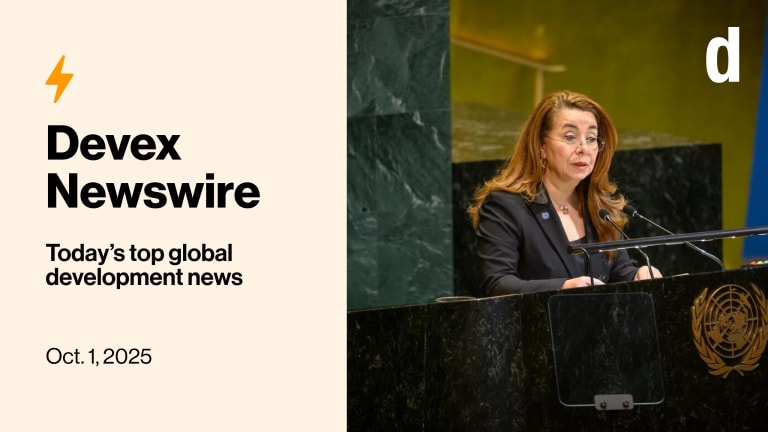
It’s been a long time coming, but it’s now official: The U.S. is pulling out of a large number of international organizations — 66 to be exact — including 31 U.N. entities that “no longer serve American interests,” according to a White House fact sheet.
The move comes nearly a year after Trump ordered a review of all “international intergovernmental organizations of which the United States is a member and provides any type of funding or other support” to determine whether they are contrary to U.S. interests or whether they can be reformed.
The “contrary to U.S. interests” part seems to have won out — with a bluntly worded presidential memorandum instructing all U.S. government agencies and departments to “cease participating in and funding 35 non-United Nations (UN) organizations and 31 UN entities that operate contrary to U.S. national interests, security, economic prosperity, or sovereignty.”
“President Trump is ending U.S. participation in international organizations that undermine America’s independence and waste taxpayer dollars on ineffective or hostile agendas,” the fact sheet states. “Many of these bodies promote radical climate policies, global governance, and ideological programs that conflict with U.S. sovereignty and economic strength.”
The list of impacted entities includes a range of multilateral organizations and U.N. agencies, including the U.N. Population Fund and a host of other agencies dealing with climate, trade, and the environment. The decision made no reference to the U.N.’s major humanitarian outfits, including the International Organization for Migration, the World Food Programme, or UNICEF, though all have faced severe U.S. budget cuts over the past year.
In fact, the withdrawal comes just days after the U.S. State Department announced it would provide the U.N. with some $2 billion in “anchor” funding for humanitarian crises in dozens of countries — a sharp drop from the $8 billion to $10 billion in voluntary U.S. funding in recent years.
“This administration is not willing to put up a few hundred million dollars a year to drive American interests through global institutions, but it is willing to bail out Argentina for $20 billion,” says Allison Lombardo, former State Department deputy assistant secretary for international organization affairs. “The inconsistency in logic is wild — America is both the strongest nation in the world but also one that can’t shape a UN agenda that advances American interests.”
Read: Trump withdraws, defunds dozens of international orgs and treaties
Beijing backs off
The incessant warnings that China will seize on America’s global retreat to expand its hegemonic power have almost become universally accepted. But the true story, at least in Beijing’s backyard, is more nuanced.
Nearly a year after the dismantling of USAID, the prediction that China would flex its foreign aid muscles in Asia has not materialized, writes Rebecca Root for Devex.
“Overall, we don’t see, at this stage, a systemic replacement of the USAID program by the Chinese one,” says Alexandre Dayant of the Lowy Institute.
In fact, of the 10 experts we interviewed, no one could identify a project in Asia where China has directly replaced USAID funding — the deadly earthquake in Myanmar in March 2025 being the notable exception.
So what’s up with the seeming hesitancy to capitalize on its superpower archrival’s absence?
China’s foreign aid budget — $3.5 billion in 2024 — remains a fraction of USAID’s former $65 billion portfolio, says Shahar Hameiri of the University of Queensland, noting that as China grapples with a slowing economy, the country isn’t in a position to increase that figure.
Even if China wanted to boost development finance, it would be “a hard sell” to its people, says Felix Brender of LSE IDEAS, given persistent domestic poverty. China is also unlikely to take over projects it did not design itself, he adds, also pointing out that it’s unlikely Beijing would quietly fund former USAID projects as the country would want its “flag or stamp on it.”
Of course, it’s difficult to say for sure what an opaque government such as China’s is up to, but becoming a foreign aid alternative doesn’t seem to be in the cards — for now at least.
“There’s no doubt that the withdrawal of U.S. aid has allowed China to win some points in the narrative battle as a more reliable aid partner,” Hameiri says, “but this doesn’t mean China is replacing the U.S. per se.”
Read: After USAID exit, China hasn’t moved to fill Asia’s funding gap
+ This story is part of The Aid Report, a Gates Foundation-funded, editorially independent initiative to track and document the on-the-ground impacts of the U.S. aid cuts with firsthand reporting and a verified, contributor-based data collection system. We’ll be featuring The Aid Report in Newswire this week. You can also go to https://www.theaidreport.us for more information.
Hitting the same notes
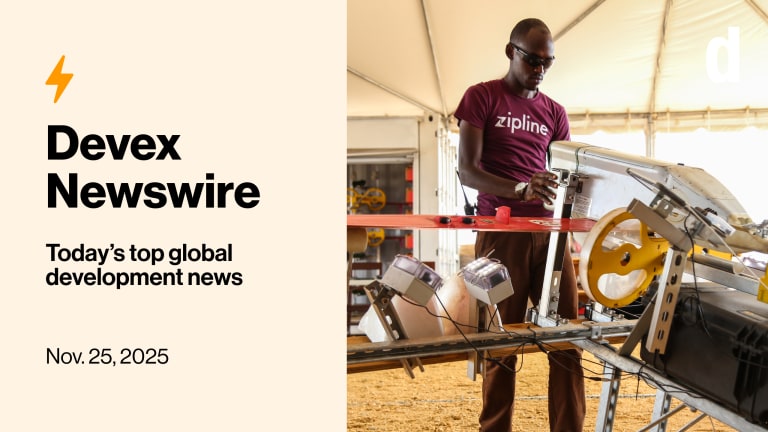
Caitlin Burton, CEO of Zipline Africa, stood firmly with the State Department’s new approach to foreign aid yesterday — so much so that Mike Henning, the president of the workers’ union that represents USAID and State Department employees, said it seemed like Burton had been “contracted to represent some of the government’s current positions.”
“I am not here as a spokesperson for the State Department,” responded Burton, speaking from a stage at the Atlantic Council, a Washington, D.C.-based think tank. “I have had a few meetings with them but I am not an expert here on them. I’m just an expert on Zipline and market-led development — that’s my thing.”
Still, the parallels were clear. Throughout her remarks, Burton spoke about the formula Zipline — an American drone company that recently received a $150 million grant from the State Department — uses for success: scaling what works, paying only for results, and expecting that governments drive and contribute to their own development. She also argued that humanitarian assistance has lingered far beyond the moments it was meant to serve, and in some cases has even crowded out capable governments, stunting the very systems it intended to strengthen.
“I just really want to applaud the State Department, because that’s what they’re doing with their commercial diplomacy strategy,” she added. “They’re trying to invest in countries in ways that treat them as peers and trade partners.”
After USAID’s collapse, dozens of African countries lost access to the agency’s global health supply chain project. But in countries where Zipline operated, Burton said governments passed those operations over to Zipline — and according to Burton, “things got better.”
“Access improved, stockouts improved, the reliability of the supply system improved, treatment rates improved,” she said. “Crisis averted, health care continued, people moved on.”
It was a claim Henning rejected. During a question-and-answer session, he spoke about the “massive death and destruction” that happened once that supply chain project — among others — was canceled. Today, experts estimate that USAID’s dismantling could lead to the death of over 14 million people.
“I think it was weird that in non-Zipline countries, after six-and-a-half decades of investment in supply systems and health systems, and I don’t know how many billions of dollars poured into it, things completely fell apart,” Burton said. “Six-and-a-half decades of investment should have left something behind that governments could carry forward and keep operating.”
ICYMI: State Dept grants $150M to Zipline to triple African drone operations
Dive deeper: Is Zipline the future of US global health assistance?
Further reading: Ex-top USAID official details wish list on health and funding fixes (Pro)
What’s next for U.S. foreign aid? Our limited-edition Devex Pro Insider’s special Saturday newsletter, led by Senior Reporter Michael Igoe, delivers exclusive insights and analyses and behind-the-scenes commentaries, and interviews with the power brokers, key players, and influencers of the new foreign aid policy straight to your inbox.
Not yet gone Pro? Start your 15-day free trial today to access all the past and future editions in addition to our exclusive news content, funding analyses, and timely Pro briefings.
In other news
The United States says that it has suspended all assistance to Somalia, alleging that officials destroyed a WFP warehouse filled with food aid it funded. [Al Jazeera]
A newly released United Nations Human Rights Office report says Palestinians in the West Bank face “systemic discrimination” by Israeli authorities. [OHCHR]
Chinese Foreign Minister Wang Yi began his annual new year tour of Africa yesterday, focusing on strategic trade access across eastern and southern Africa. [Reuters]
Sign up to Newswire for an inside look at the biggest stories in global development.
About the author

Anna Gawel
Anna Gawel is the Managing Editor of Devex. She previously worked as the managing editor of The Washington Diplomat, the flagship publication of D.C.’s diplomatic community. She’s had hundreds of articles published on world affairs, U.S. foreign policy, politics, security, trade, travel and the arts on topics ranging from the impact of State Department budget cuts to Caribbean efforts to fight climate change. She was also a broadcast producer and digital editor at WTOP News and host of the Global 360 podcast. She holds a journalism degree from the University of Maryland in College Park.