



Presented by Munich Security Conference
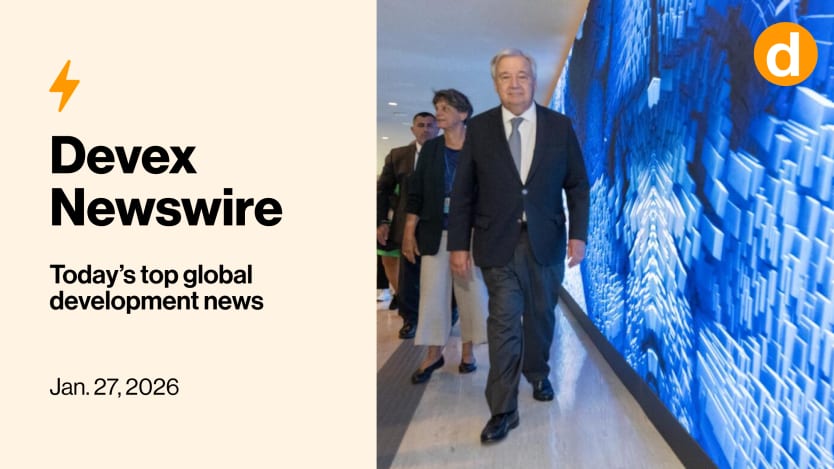
United Nations agencies are embracing AI to stretch shrinking budgets and meet rising demand. Some staff are eager to experiment, but leaders warn enthusiasm needs guardrails. With more than 700 AI pilot projects undertaken across the U.N. in 2024–2025, execution — not access — is now the real test.
Also in today’s edition: Some hoped China would step up to fill gaps created by the demise of USAID, but the numbers tell a different story.
+ Join us this Thursday, Jan. 29, for a Pro Briefing with the Devex reporters who cover the U.S. government — and were on the front lines of the Trump administration’s upending of the U.S. foreign aid system — to look in detail at the latest U.S. foreign assistance bill, the State Department strategy and leadership, and the ongoing battle over the remnants of USAID. Save your spot now.
Speed meets guardrails
U.N. agencies are racing to put artificial intelligence to work — not just to keep up with the tech, but to stretch shrinking budgets and meet growing demands from staff and partners. Dedicated AI teams are popping up across the system, while others are retrofitting existing tools to boost translation, communications, and frontline service delivery.
The push is coming from both the top and the bottom. Claire Melamed, vice president for AI and digital cooperation strategy at the UN Foundation, says agencies are being pulled between caution and urgency. “There’s also the pressures of individual staff who can see opportunities and who are just raving to put them into practice and an institution that is confronting serious challenges of resourcing, rising expectations, falling budgets, and who think, often quite rightly, that technology can help them.”
Leaders stress that enthusiasm has to be matched with guardrails, writes Emma Smith for Devex. Khuloud Odeh, chief information officer at the International Telecommunication Union, says AI can help staff deliver more value — but warns that controlling its use is difficult, as employees will experiment regardless. At the United Nations Development Programme, Chief Digital Officer Robert Opp points to persistent data and equity risks, while underscoring the upside: “We believe that digital technologies, including AI, can make a major difference in the way that we approach our work and support development across countries.”
Experimentation is widespread — from refugee services to food assistance — but results are mixed. According to Sameer Chauhan, director at the UN International Computing Centre, of the hundreds of AI pilot projects across the U.N., “very few [pilots] end up going to fruition … and very few end up achieving the outcomes we thought they would.”
Read: UN agencies embrace AI as budgets fall and staff demand rises (Pro)
+ Devex Pro members can get the most out of our coverage on how AI is being integrated into global development work. Not yet gone Pro? Experience unlimited access to expert analyses, hidden funding opportunities and career resources, and connect with key sector players and influencers at exclusive events and briefings when you start your 15-day free trial of Pro today.
Unblocking the chain
Last week, the Circle Foundation announced it is expanding a blockchain-based payment platform to 15 U.N. agencies, a move that could fundamentally change how aid reaches people.
“The reality is that movement of value is happening on legacy rails,” said Elisabeth Carpenter, the chief strategic engagement officer at Circle. “And for anyone here who has ever tried to make cross-border payments, for example, it is fraught with friction.” More than $38 billion in humanitarian aid still moves through traditional banks every year.
The stakes are high, writes Global Development Reporter Elissa Miolene. When Afghanistan’s banking system collapsed in 2021, the U.N. had to fly 68 shipments of U.S. banknotes worth $2.4 billion into the country — an extraordinary workaround that exposed major security and operational risks.
The UN Refugee Agency and partners have been testing blockchain and stablecoin payments since 2021, including in Ukraine, where recipients received funds directly to digital wallets and could cash out locally or transfer to banks. Others have seen dramatic gains through other programs: Mercy Corps cut transaction costs by 75% and settlement times by 90% in a Kenya pilot.
Read: United Nations taps blockchain to speed up aid
+ For more insider brief on development finance, sign up for Devex Invested, our free, Tuesday newsletter on business, finance, and the SDGs — and get the latest edition in your inbox later today!
The democracy dilemma
At the World Economic Forum in Davos last week, panels such as “Is Democracy in Trouble?” hinted at a shift: Democratic erosion is no longer just a political problem — it’s a business risk. As polarization deepens and information integrity frays, companies are being forced to reckon with whether they can, or should, play a role, writes Semuhi Sinanoğlu, a researcher at the German Institute of Development and Sustainability, in an opinion piece for Devex.
Many critics say business has failed the test, with leaders bending under political pressure. But historically, businesses have often used their economic leverage to support democracy — financing opposition movements, protecting civic space, and backing independent media. Today, amid worries about political retaliation, companies are relabeling diversity, equity, and inclusion programs; supporting civil society behind the scenes; and building contingency plans to protect workers. Or, as Sinanoğlu writes, “just because it’s under the radar doesn’t mean it’s not happening.”
Where business engagement is most urgent now is fighting “foreign information manipulation and interference” — FIMI — which exploits platforms, advertising systems, and weak governance to erode trust. The costs are real: Fake news drains $78 billion from the global economy each year. That’s why the European Democracy Shield program is seeking to bring businesses into coalitions that defend information integrity, by investing in editorially independent media and demonetizing campaigns to misinform the public.
Opinion: Can the private sector help safeguard democracy? The answer is yes
Blank pages
The United Kingdom’s aid budget drama rolled on last week — with no numbers, no timeline, and plenty of tension. Appearing before members of the U.K. Parliament, Development Minister Jenny Chapman confirmed that long-overdue multiyear aid allocations for 2026–29 still aren’t ready, months after they were promised, as the Foreign, Commonwealth & Development Office tries to cope with a 40% cut to overseas development spending.
Chapman offered little comfort on timing. The figures, she said, would be published “as soon as possible.” “We’re almost done,” she added. “I’m hoping it’s very, very soon — and I know I said that last time.” The delay, she said, is down to updated impact assessments — a process aid groups argue has already become a box-ticking exercise.
The hearing also raised fresh questions about oversight, writes Susannah Birkwood for Devex. Chapman openly wondered whether spending around £5 million a year on the Independent Commission for Aid Impact still makes sense. “This is a prioritization situation,” she said. “I have to ask myself whether that is the right use of that money. Leaving things the same is not an option.” Aid groups, including Bond, warn that weakening ICAI risks hollowing out transparency just as the budget shrinks.
Read: UK aid allocations delayed; new numbers promised ‘as soon as possible’
The great leap backward
When USAID collapsed, many predicted China would be the superpower to help plug development finance gaps. But new reporting from the ONE Campaign indicates that lending from China has actually declined in recent years, my colleagues Elissa Miolene and Jesse Chase-Lubitz tell me.
“Chinese finance has basically gone into a great reversal,” says David McNair, the executive director of global policy at the ONE Campaign, an advocacy organization focused on Africa.
The report finds that Chinese inflows — barring foreign direct investment, which the analysis did not cover — to low- and middle-income countries went from $26.5 billion in 2018 to just $5.1 billion in 2024. During the same time period, 20 low- and middle-income countries paid more in debt servicing than they received in loans, resulting in a net outflow of $33.8 billion, the report finds.
In particular decline is China’s financing to Africa, which was one of the primary recipients of the country’s global infrastructure juggernaut, the Belt and Road Initiative. From 2010 to 2014, Africa received $30.4 billion from China. From 2020 to 2024, the continent paid out $22.1 billion.
“Net transfers on debt have in fact flipped to negative because repayments have continued, but new debt commitments have been slow for the last decade,” says Rebecca Ray, a senior academic researcher with the Global China Initiative at Boston University. “That’s just arithmetic, and an inescapable aspect of the way these things were scheduled.”
ICYMI: After USAID exit, China hasn't moved to fill Asia’s funding gap
In other news
Billionaire philanthropist Michael Bloomberg has pushed his climate spending beyond $3 billion, becoming a major global funder as governments and other philanthropists step back amid a renewed retreat from climate action. [Financial Times]
The U.K. has become the second G7 country to lose its measles-free status — after Canada — with rising cases and deaths linked to falling MMR vaccination uptake. [BBC]
Rising debt in G7 nations is dragging down global growth and worsening borrowing pressures in low-income countries, as higher interest rates and tighter public finances spill beyond advanced economies, the International Monetary Fund warns. [New York Times]
Sign up to Newswire for an inside look at the biggest stories in global development.
About the author

Helen Murphy
Helen is an award-winning journalist and Senior Editor at Devex, where she edits coverage on global development in the Americas. Based in Colombia, she previously covered war, politics, financial markets, and general news for Reuters, where she headed the bureau, and for Bloomberg in Colombia and Argentina, where she witnessed the financial meltdown. She started her career in London as a reporter for Euromoney Publications before moving to Hong Kong to work for a daily newspaper.
Search for articles


Most Read
- 1
- 2
- 3
- 4
- 5