

Presented by The Rockefeller Foundation

The Trump administration is proposing a new Bureau of Disaster and Humanitarian Response at the U.S. State Department, separating relief work from migration policy. Supporters call it a needed fix after USAID’s dismantling; critics say key questions remain unresolved.
Also in today’s edition: What did donors spend on multilateral aid in 2024? And CEPI launches a fresh bid for funding.
Happening today: See you soon at 9 a.m. ET for a Pro Briefing with Dr. Mohamed Yakub Janabi, WHO regional director for Africa. We’ll explore how the continent’s health system is navigating aid cuts and the role of the WHO Africa office in building sustainability. You can still register here. We’ll send you a recording if you can’t attend live.
Another aid reboot
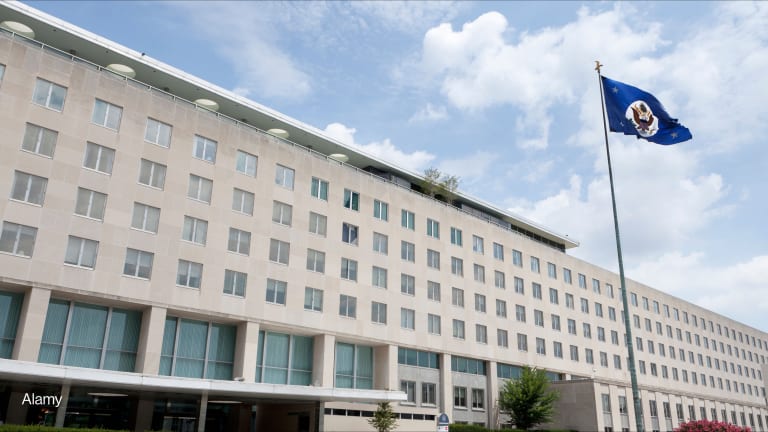
Just months after dismantling USAID and absorbing its pared-back humanitarian functions, the Trump administration is preparing yet another overhaul — this time reshaping how the State Department handles international disaster response.
A proposed organizational chart obtained by Devex would create a new Bureau of Disaster and Humanitarian Response, pulling emergency relief out of the Bureau of Population, Refugees and Migration and separating it from migration policy.
The new bureau would be led by a Senate-confirmed assistant secretary and broken into three channels: disaster and response, programs and coordination, and technical and operations. “After months of figuring out what works with delivering foreign assistance at State, this makes a lot of sense,” a current State Department official says.
On Capitol Hill, reactions are mixed, write my colleagues Elissa Miolene and Michael Igoe. “On its face, the proposal is a step in the right direction given the importance of consolidating humanitarian assistance and separating out the domestic migration policy work,” a congressional staffer familiar with the reorganization discussions says. “However, look a little closer and it’s characteristically half-baked and leaves numerous decisions unresolved, from unclear responsibility over food security development programming to bifurcated management of relationships with U.N. partners.”
Food security is one of the murkiest pieces. With the Food for Peace program already moved to the U.S. Department of Agriculture, it’s unclear where certain global food programs will land — even as the State Department touts new investments. “The United States continues to strengthen U.S. food systems and secure our nation’s economic and agricultural dominance,” a State Department press release stated this week.
For some former officials, the plan signals a quiet course correction after months of layoffs, shuttered offices, and a “reduction in force” that hollowed out humanitarian expertise. “I do feel like this is a good step forward,” a former senior USAID official says, calling it a “recognition” that the State Department needs to rebuild capacity. Still, this would mark the second major restructuring of U.S. humanitarian aid in six years — and it comes after thousands of experienced staff were already shown the door.
Exclusive: US State Department proposes humanitarian overhaul
ICYMI: State Department scrambles to rebuild foreign aid workforce (Pro)
Racing the next outbreak
The Coalition for Epidemic Preparedness Innovations is back in fundraising mode — and it wants at least $2.5 billion to bankroll the next phase of its pandemic playbook. Under its new CEPI 3.0 strategy, the ambition is bold: Spot a new threat and have a vaccine ready to roll within 100 days.
The full vision carries a $3.6 billion price tag, writes Senior Reporter Jenny Lei Ravelo. So far, $1.1 billion is in hand, rolled over from existing backers and early pledges, including from Germany. “If we’re fully funded through our new strategy, we think we can cover over three-quarters of the threats that may emerge today and in the coming years,” Aurélia Nguyen, CEPI’s deputy chief executive officer, tells Jenny.
And the threat list isn’t exactly shrinking. Think zoonotic spillovers, lab accidents — even AI-enhanced pathogens. “There is [a] huge opportunity for rapid vaccine development in artificial intelligence. But it also comes with risks that we need to address, because in the wrong hands, there can be AI-enhanced forms of virus, which could cause a huge havoc from a health and economic perspective,” Nguyen says.
CEPI insists its plan isn’t theoretical. During a recent Rift Valley fever outbreak, its partners at the Serum Institute of India turned around 400,000 doses in just 16 days. “They knew the technology really well. They just needed to adapt it to that specific pathogen, and they were able to put doses out in an absolutely record time,” Nguyen says.
The pitch to donors will stretch through 2026 — no splashy replenishment summit, just steady outreach. “So unlike other replenishments that have happened recently, it’s not a big bang event. We’ve actually listened to our investors, and we’ll be adapting to their timelines throughout the year,” Nguyen says.
Yes, it’s an “incredibly tough [fundraising] environment.” But compared to the trillions COVID-19 cost the global economy? “It may sound like a lot of money in absolute terms, but when we think about the cost of inaction, and when we think about the cost of former health emergencies … that is really a drop in the ocean,” she says.
Read: CEPI seeks $2.5B to address health threats, including AI-enabled risks
AfCFTA, minerals, and Munich
At the African Union Summit, the African Continental Free Trade Area, aka AfCFTA, took center stage as leaders pushed ahead with tariff cuts to boost intra-African trade and industrialization — alongside plans for strategic mineral corridors to anchor supply chains. U.S. officials promised investments would benefit local communities, not exploit them.
At the Munich Security Conference, the global south was notably underrepresented. Traditional aid took a back seat to hard security, but development finance kept surfacing as a core theme — with many arguing that smart investment is a prerequisite for global stability.
Senior Reporter Adva Saldinger unpacks it all with colleagues Ayenat Mersie and Jesse Chase-Lubitz in the latest episode of our podcast, This Week in Global Development.
Listen: What we learned at the African Union Summit and Munich Security Conference
+ You can also listen on Spotify, Apple Podcasts, Soundcloud, YouTube, or search “Devex” in your favorite podcast app.
Who funds multilaterals?
Before U.S. President Donald Trump’s 2025 aid overhaul upended the system, multilateral funding was already shifting. New OECD data shows Development Assistance Committee donors sent $90.8 billion — 41% of total official development assistance — through multilaterals in 2024. That’s down nearly $17 billion from the year before.
Here’s how it works: Some aid goes in as core contributions (pooled, flexible funding), and some as “bi-multi” aid — earmarked cash routed through multilaterals for specific projects. In 2024, donors gave $50.3 billion in core funding and $40.6 billion in bi-multi aid. Both fell, driven largely by U.S. and German cuts.
The United States still led the pack, contributing $23.2 billion — more than a quarter of all multilateral aid — followed by Germany at $11.8 billion. France, the United Kingdom, Japan, Canada, and Italy rounded out the top tier.
So who got the biggest slices? Our analyst Miguel Antonio Tamonan explains.
The EU’s development budget topped the list at over $19 billion, funded entirely by European donors. The World Bank’s International Development Association received $6.5 billion in core funding, with the U.S. providing about one-fifth. Check out Miguel's analysis to find out how much went to the World Food Programme, The Global Fund to Fight AIDS, Tuberculosis and Malaria, the UN Refugee Agency, and other multilaterals.
All figures are in 2024 U.S. dollar prices and reflect gross disbursements — a reminder that even before last year’s political shocks, the multilateral system was already under strain.
Read: What did donors spend on multilateral aid in 2024? (Pro)
+ Interested in more funding coverage? Start a five-day free trial of Devex Pro Funding today and get exclusive access to detailed funding analysis and policy reports from major institutions and explore the latest funding opportunities from over 850 funders with the data analysis and industry intelligence you need to win them.
In other news
The U.S. has only paid about $160 million of nearly $4 billion in outstanding dues to the United Nations. [AP]
Venezuela is in a fragile economic and humanitarian situation according to the International Monetary Fund, with hyperinflation, a weakening currency, and nearly 8 million people having left the country. [Al Jazeera]
The U.S. has threatened to withdraw from the International Energy Agency if the global body does not shift away from a climate‑focused agenda. [The New York Times]
Sign up to Newswire for an inside look at the biggest stories in global development.
About the author

Helen Murphy
Helen is an award-winning journalist and Senior Editor at Devex, where she edits coverage on global development in the Americas. Based in Colombia, she previously covered war, politics, financial markets, and general news for Reuters, where she headed the bureau, and for Bloomberg in Colombia and Argentina, where she witnessed the financial meltdown. She started her career in London as a reporter for Euromoney Publications before moving to Hong Kong to work for a daily newspaper.