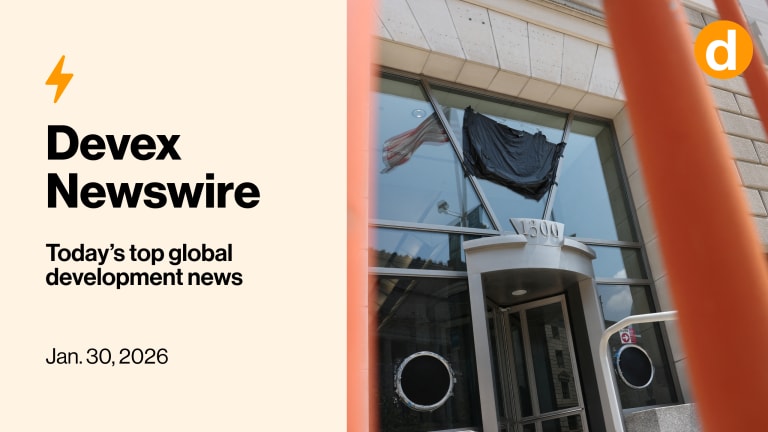




USAID programs helped shield young people from gangs in Colombia. But when they collapsed, places such as Quibdó, where youth homicide is rampant, saw armed groups fill the void. Some local leaders press on — but without funding, the gains are slipping away.
Also in today’s edition: Debates over whether climate change response counts as national security, and Finnish politician Pekka Haavisto’s new gig.
👋 See you soon at 9 a.m. ET: Today, we’ll be hosting a Pro Briefing with leaders with expertise in defending NGOs in the U.S. and beyond to discuss how NGOs can adapt, survive, and thrive in a hostile funding and political environment.
Can’t attend live? Register anyway, send in your questions, and we’ll send you a recording.
Violence fills aid vacuum
The Trump administration’s decision to dismantle USAID early last year, didn’t just close an agency — it pulled the scaffolding out from under some of the world’s most vulnerable communities.
When Luz Mely Moreno walks through Reposo, the gang-controlled neighborhood where she grew up in Quibdó, northwestern Colombia, she counts her blessings: She’s alive, she’s not in prison, and she’s one semester away from completing a psychology degree. For that, she credits a USAID-backed program that no longer exists.
Before USAID shut down, the Youth Resilience program helped 3,100 young people in Quibdó and rehabilitated around 200 gang members. “I know that if I hadn't found out about that program in time, I would also be in prison like my brothers,” says 26-year-old Moreno. When the funding vanished, “we felt abandoned,” she recalls. And armed groups such as the Gaitanist Self-Defense Forces of Colombia have moved into the vacuum.
But some initiatives limp on, writes Alfie Pannell for Devex. “These programs and projects save lives. And every time we invested in a project, we saved lives,” says Harold Palacios, the founder and director of Black Boys Chocó. But with less funding, relapses are real: “There are some who do get stronger, study, leave,” Palacios says. “But there are others who can’t resist those urges … and within a few days they are killed.” In the first nine months of 2024, 145 young people were killed in Quibdó, a city of roughly 150,000.
Read: USAID moves out, gangs move in — the cost of aid cuts in Colombia
📍 This story is part of The Aid Report, a Gates Foundation-funded, editorially independent initiative to track and document the on-the-ground impacts of the U.S. aid cuts with firsthand reporting and a verified, contributor-based data collection system. For more information and to read the stories, go to https://www.theaidreport.us.
Numbers game
The Global Fund to Fight AIDS, Tuberculosis and Malaria is allocating just $10.78 billion for 2026–2028 — its lowest country grant total since 2020. It was set at $13.1 billion for 2023–2025, though that was later cut by $1.43 billion amid donor uncertainty. The fund had aimed to raise $18 billion in its most recent replenishment, but brought in just $12.6 billion, with $4.6 billion of that from the U.S. government.
The backdrop: shrinking bilateral aid, shuttered services, and growing strain on HIV, TB, and malaria programs, writes my colleague Jenny Lei Ravelo. NGOs are calling the allocation “another gravely concerning sign of donor retreat.”
Catalytic funding — meant to plug gaps in areas such as human rights and gender barriers — is set at $260 million, plus $306 million in earmarked private funding, though it’s unclear how much will go to rights-based work. Blessina Kumar, CEO of the Global Coalition of TB Advocates, warns: “The danger is that this will be left midway.”
As the Global Fund Advocates Network puts it: “The opportunity for impact will be less than it could have been and fewer people will benefit and the risks overall for communities are significantly higher than if the Global Fund’s $18 billion investment case had been fully funded.”
Read: Global Fund fundraising shortfall hits country allocations
🩺 For the latest insider reporting from Jenny and the rest of our global health team, be sure to sign up to Devex CheckUp, a free, Thursday newsletter.
AI at AU
Although the world’s most prominent AI gathering this month took place in India, artificial intelligence was a topic of conversation at the recent African Union Summit in Addis Ababa, Ethiopia, too.
According to Gaspard Banyankimbona, the AU education, science, technology and innovation commissioner, one of the big concerns was ensuring that AI would be available in local African languages. Without that, he warned, large parts of the population risk exclusion. “If you don’t make it today, then anyone who is not comfortable in English, French, or even Chinese … will be lost completely,” he said.
My colleague Ayenat Mersie asked the commissioner what the AU was doing to ensure Africa wouldn’t get left behind, and he said they were lobbying on the issue, pushing companies to localize content and reflect African contexts. He cited direct engagement with Google: “I had an opportunity to receive the vice president of Google in my office,” he said, describing “a big, big, big, big ambition and big investment.” He declined to disclose the dollar amount, saying he could not mention it because it was not his business to do so. Google’s Africa office is based in Nairobi, Kenya, he added, and Kiswahili is already integrated into some systems, with additional African languages underway.
He also floated the idea of an African AI alliance — which he described as an association of associations that would form a network to exchange knowledge and keep African researchers and institutions at the same level of understanding as the technology evolves — arguing the continent cannot afford to wait for others to shape AI before trying to catch up.
ICYMI: The global south demands a voice on AI at India summit
Background reading: Donors commit $10M to include African languages in AI models (Pro)
🤖 Devex Pro members can access all our coverage on how AI is being integrated across the global development sector.
Not yet gone Pro? Experience unlimited access to expert analyses, hidden funding opportunities, and career resources with recruiters’ insights, and connect with key sector players and influencers at exclusive events when you start your 15-day free trial of Pro today.
Weather you like it or not
At the Munich Security Conference earlier this month, much of the discussion was all tanks and troop numbers. But for many global south leaders, the real threat isn’t military.
“Climate change has become a threat to the existence of the Maldives,” said Abdulla Khaleel, the Maldivian minister for foreign affairs. “It’s not the bombs, it’s not the terrorists. We are facing a different kind of terrorism.”
As NATO debates higher defense spending and development budgets shrink, experts warned that sidelining climate change is short-sighted. “We need to focus more on preventative investments and the upstream investments,” Erin Sikorsky, the director of the Center for Climate and Security, told my colleague Jesse Chase-Lubitz.
With fragile states receiving less than 10% of global climate finance — and research linking rising temperatures to higher conflict risk — development leaders argued resilience is security. As Sikorsky said: “You can buy all the new tanks and the new weapons you want … but if your roads are crumbling … it doesn’t matter.”
Read: Should the defense spending ramp-up also tackle climate change?
Consolation prize
Finnish politician and diplomat Pekka Haavisto, who was recently passed over for the top U.N. refugee job, has been appointed personal envoy of the U.N. secretary-general for Sudan, replacing Ramtane Lamamra of Algeria.
The former Finnish foreign minister has previously served as a U.N. adviser and European Union envoy, overseeing peace negotiations in Darfur. He has also served as a special Finnish envoy for mediation and crisis management in Africa.
Your opinion matters
Global development is shaped by negotiations, incentives, institutional politics, and financial flows — but too little of that story gets told by the sector itself.
To help bring these insights to our readers, we’ve updated Devex’s opinion guidelines. We are inviting development movers and shapers to submit sharp, analytical, behind-the-scenes perspectives on how power and money move in the sector — and what that means for real-world outcomes.
If you’ve seen how decisions are made inside agencies, donor capitals, multilateral development banks, or funding mechanisms, this is your invitation to unpack what’s really going on.
👉 Catch up on the new guidelines and how to submit here.
Green shoots
The sustainability backlash has been hard to miss this past year, as reports of companies softening or shelving climate commitments have piled up.
But Sanda Ojiambo, assistant secretary-general and head of the United Nations Global Compact, says the corporate picture looks far less dire.
“Close to 90% of the CEOs we interviewed said that they felt that the business case for sustainability was stronger now more than ever,” Ojiambo tells Ayenat, citing a 2025 survey conducted by the U.N. Global Compact, the the U.N.’s voluntary corporate sustainability initiative.
Ojiambo didn’t gloss over the politics. “We’ve seen massive rollbacks, primarily at the policy and political level,” she says. But she drew a distinction between government retrenchment and corporate strategy — particularly in Africa.
“Africa’s building up its own sustainability pieces,” she says. “Many [in the] African private sector tell us they are more investable and can access capital better if they’re able to show their green credentials, their inclusivity credentials, etc. So the rollbacks are happening, but it doesn’t mean that business should not take care of what they know makes sense for the long term.”
In Addis, she pointed to water as one area where that long-term logic is translating into concrete action. The Global Compact works with companies on water resilience and stewardship — reducing water use in production, limiting pollution, and improving recycling and reuse. It is also backing a goal of restoring 100 water basins by 2030 and supporting efforts to build an investment platform to channel capital into basin restoration.
Her message: Political headwinds may shift, but many executives still see sustainability as closely tied to capital access and long-term competitiveness.
In other news
Zimbabwe blocked a $350 million U.S.-funded health deal, objecting to national data access over worries that it would undermine national sovereignty and bypass multilateral health institutions. [Business Insider Africa]
Somalia’s food crisis is set to intensify, with 6.5 million people at risk of severe hunger by the end of March due to drought, conflict, and global humanitarian aid cuts. [AP]
Israel is moving to ban at least 37 humanitarian groups from operating in the occupied Palestinian territory unless they submit information on their Palestinian staff, a move aid groups warn could put local workers at risk. [Al Jazeera]
Sign up to Newswire for an inside look at the biggest stories in global development.
About the author

Helen Murphy
Helen is an award-winning journalist and Senior Editor at Devex, where she edits coverage on global development in the Americas. Based in Colombia, she previously covered war, politics, financial markets, and general news for Reuters, where she headed the bureau, and for Bloomberg in Colombia and Argentina, where she witnessed the financial meltdown. She started her career in London as a reporter for Euromoney Publications before moving to Hong Kong to work for a daily newspaper.