




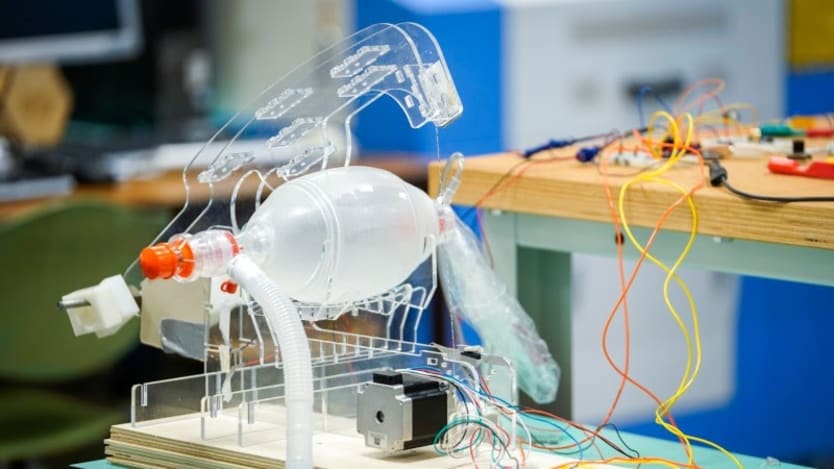
Crises generate a lot of energy that, if harnessed constructively, can be a great source of innovation. The COVID-19 response is producing inspiring innovative responses proving that, indeed, necessity is the mother of invention. What has emerged already and during previous crises provide lessons for our near-term response, but also highlight the underlying and more critical long-term need to better resource and institutionalize strategic innovation in global health.
More USAID news:
► USAID advice for business partners in responding to COVID-19
► USAID issues 'urgent request' for COVID-19 medical equipment
► Despite flexible USAID funding guidance, aid groups face long-term challenges
Open innovation, for example, is a proven model that can focus this energy and catalyze problem-solving from anywhere and anyone. My former team at the USAID Center for Innovation and Impact led both the Fighting Ebola and Combating Zika and Future Threats grand challenges during those respective outbreaks.
In the heart of the Ebola outbreak, for example, CII and international experts reviewed over 1,500 ideas and quickly supported the development of 14. Twelve of these innovations have been tested in West Africa, and over half are in use today.
How should we think about the role of innovation in the midst of the current global crisis?
Firstly, innovation is so much more than just developing new widgets. Global health innovation can be defined across four categories: 1. Offering, i.e. the widget, 2. delivery, 3. finance, and 4. process. We are seeing urgent COVID-19 innovation needs across all these categories, such as behavior change to support social distancing, and supply chain solutions, to name a few. Last Mile Health, a pioneering community health program in Liberia, for example, is sharing its process innovations developed during the Ebola outbreak to aid in the response to COVID-19.
Second, innovation platforms that address immediate needs should also keep sustainability in mind. Sourcing innovation, whether through open competitions, prizes, or otherwise, can have immediate impact but should be shaped with long-term sustainability in mind.
One of the products that came out of the Fighting Ebola grand challenge was Shift Labs’ DripAssist. It is an FDA approved infusion monitor providing a safer and more accurate way to deliver fluids. In addition to use in over 20 low- and middle-income countries already, Shift Labs is now poised to support the expansion of COVID-19 surge capacity in the US, Canada, and the U.K. While the Ebola crisis was the catalyst to accelerate its implementation, all the development was done with the long-term in mind.
Third, we should look to LMICs and low resource settings for innovations and innovation models. We are quickly realizing that the term “low-resource setting” doesn’t always apply just to LMICs. Product innovations such as DripAssist and Gradian, and OneBreath ventilators, which were developed for LMICs, are finding so-called reverse innovation opportunities now.
We are also seeing reverse innovation in the processes to source innovations themselves. An example is CamTech, which has been a health innovation platform in East Africa and India, now being brought to Boston through the SpringBoard Studio to develop new ways of providing safer and higher throughput testing for COVID-19 patients.
And lastly, local communities need to be at the center of defining the problem and developing solutions. All too often, end-users aren’t at the heart of understanding a health care need and solving it. Human-centered design, at a minimum, provides guiding principles to engage end-users, but when used optimally, is a skill-set, a mind-set, and a process that can result in transformational solutions.
Groups such as D-Rev, the Nairobi Design Institute, and Stanford BioDesign have been successfully using human-centered design in low-resource settings for years. USAID’s CII and the Bill & Melinda Gates Foundation developed Design for Health to capture these best practices, build a community, and drive better use of human-centered design in global health.
So what can donors, policymakers, and implementers take from what we are seeing to impact this current COVID-19 response, and longer-term, for their global health work more generally?
Here are four ideas:
1. Identify, vet, and share
Given the urgency and speed of innovation happening, there are important opportunities to share existing and emerging innovations of all types. Whether it be promising behavior change models using social media, DIY face shields, low-cost ventilators, AI enabled COVID chat rooms, or the bevy of emerging innovations to come, donors and policymakers, at a minimum, should serve as conduits to identify, vet, and share the best.
Some current efforts to source and share existing innovations are USAID’s health innovation RFI and the Global Innovation Exchange.
2. A global call for innovation
We can’t let this crisis go to waste and miss this opportunity to leverage the abundant energy, altruism, and new resources in a big and meaningful way for the long-term. One model could be a bold call for innovation; one that’s aligned across governments and funders and is grounded in the needs of the communities themselves. Wraparound acceleration services would be essential in ensuring immediate impact and long-term sustainability.
3. Strengthen investments in global health R&D — AKA, the ‘no brainer’
As we see with the huge economic toll of this pandemic, greater investments in development platforms for diagnostics, vaccines, and therapeutics would pay for themselves many times over. To start, we should bolster and better align broader USG investments in global health research and development and strengthen collaborative platforms including CEPI, UNITAID, and new initiatives such as the Global Virome Project.
4. Institutionalize strategic innovation for the long-term
“Innovation” has become a buzzword that can mean everything and nothing, and elicits a range of reactions — from excitement to skepticism. We know, though, that smartly investing in the future through innovation works best when it's strategic, focused on impact, and resourced.
Operationalizing a proactive innovation strategy should be more science than art. Some things to consider are how will innovation be centralized or embedded throughout the organization, how will it be resourced and staffed, and how will its impact be measured? Innovation Realized is a great resource highlighting broad global health innovation principles.
Let’s meet this moment by using smart innovation to help tackle this current challenge and to be better positioned to solve tomorrow’s problems with tomorrow’s solutions.
Visit our dedicated COVID-19 page for news, job opportunities, and funding insights.
About the author

David Milestone
David Milestone is the former acting director of USAID’s Center for Innovation and Impact. Prior to joining USAID in 2012, Milestone held various roles at Stryker, where he led innovation, introduction, and strategy initiatives in India. He has also worked as a management consultant with AT Kearney and as a design engineer at Boeing.
Search for articles



Most Read
- 1
- 2
- 3
- 4
- 5