The USAID awards the Trump administration killed — and kept
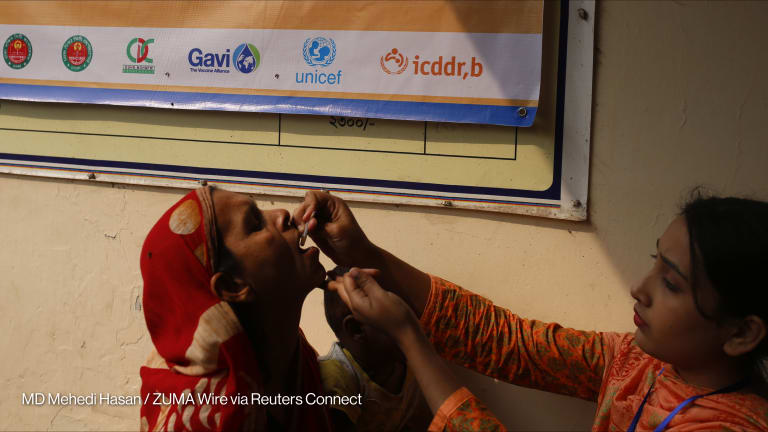
At the top of the list of terminations sent to Congress is a cut in funding to Gavi — an organization that purchases vaccines for millions of children across the world. An award to the Global Fund, on the other hand, was spared.
The Trump administration has shared documents with the U.S. Congress containing what appears to be a complete list of all 5,341 terminated USAID programs — along with 898 that are still active. The documents reveal the administration has terminated 86% of programs from the U.S. Agency for International Development — marginally more than the 83% reported on March 10 by U.S. Secretary of State Marco Rubio. In total, the document contains details of the termination of programs worth $75.9 billion. Of that total, $48.2 billion was already obligated, which means those funds were assigned or committed, but not necessarily paid out to an implementing organization. This leaves some $27.7 billion from these terminated programs with money yet to be obligated. The remaining awards are worth $78 billion, of which $69.7 billion has been obligated by Congress, and $8.3 billion has yet to be. This means that 23% of the total remaining unobligated funds are to be retained. The 281-page spreadsheet containing the awards, first reported on by The New York Times, is now widely circulating in the aid community, along with another 93-page document sharing cuts to the U.S. State Department. The cuts were also detailed in a pair of detailed memos sent to Congress on Monday. The spreadsheet indicates that the U.S. has cut a $2.6 billion award for Gavi, the Vaccine Alliance — an organization that purchases vaccines for millions of children across the world. Some of this funding has already been spent. But Dr. Sania Nishtar, the chief executive officer of Gavi, told Devex that the organization has not received a termination notice from the U.S. government, and Congress had approved $300 million for the organization’s activities this year. Gavi is just one of the programs on the termination list at USAID, the result of the Trump administration’s foreign aid overhaul over the last nine weeks. Throughout the last two months, program after program has been severed from what used to be the largest bilateral aid agency in the world. Now, the details of those cuts have been documented in the spreadsheet presented to Congress on Monday night, along with another detailing cuts at the State Department. While Gavi was on the termination list, the Global Fund to Fight AIDS, Tuberculosis and Malaria was spared, with $13.4 billion on the ledger from 2017 until 2027 — although all that funding has already been obligated. The Famine Early Warning Systems Network, or FEWS NET, will also be retained, potentially bringing a widely used famine prediction tool back online. “This update reflects USAID’s ongoing efforts to manage its resources efficiently while fulfilling its mission to continue to provide life-saving and strategic aid assistance worldwide,” Ryan Shrum, USAID’s senior adviser for legislative and congressional affairs, said in the accompanying letter sent to Congress on Monday night. “A cut in Gavi’s funding from the US would have a disastrous impact on global health security, potentially resulting in the deaths of over a million children over five years.” --— Dr. Sania Nishtar, CEO, Gavi, the Vaccine Alliance Shrum explained that the surviving awards were those focused on “strategic and life-saving aid, including emergency food assistance and life-saving global health activities,” which included those under the U.S. President’s Emergency Plan for AIDS Relief, or PEPFAR. Those lost span nearly every sector, from malaria programs in Zambia to humanitarian assistance in Afghanistan. What the data spreadsheet doesn’t show is exactly how much funding is expected to be cut because it is unclear how much of the obligated expenses have already been paid out. Traditionally the agency needs to follow a process and notify Congress if it plans to change funding obligations or will not spend certain funds, including requesting a rescission. And though the State Department fared better than USAID — retaining nearly 60% of its programs as opposed to one-seventh — State still lost 2,100 programs, totaling $4.6 billion altogether. Paul Guaglianone, a senior official at the State Department’s Office of Legislative Affairs, broke down the details in his letter to Congress: Today, just 399 contracts and 2,500 grants are left at the State Department, totaling $1.8 billion and $13.5 billion, respectively. “We expect and demand more information about this ‘review,’” wrote a group of Democratic lawmakers in the Senate Foreign Relations Committee, which penned a letter after the list began circulating on Wednesday. “The sweeping terminations of U.S. foreign assistance have been done in violation of U.S. law. We expect Secretary Rubio to immediately appear before the Committee to provide answers on these actions and their implications for U.S. national security.” <div id="usaidloss"><h2>What is expected to be lost at USAID?</h2></div> USAID’s 281-page spreadsheet — and the State Department’s 93-page one — lists thousands of awards. The document lists the total award amounts, the start date of the contract, and when it was originally planned to end. This means that in many cases, some of the award amount has already been spent by the organization. While Congress determines government spending levels, agencies, in consultation with Congress, then assign or “obligate” those funds to specific programs. This document includes the total amount of each award obligated but does not specify how much has already been paid. At the top of the list of terminations is Gavi. The organization is in the midst of its replenishment cycle for its upcoming work from 2026 through 2030. Last June, the Biden administration pledged at least $1.58 billion for this new funding cycle to the organization — money that would still need to be allocated by Congress. The spreadsheets list a termination of a $2.6 billion award to the organization from 2022 through 2030, $880 million of which was already obligated by the agency after being approved by Congress. The funding previously obligated has likely been paid to Gavi, which received a $300 million payment from the U.S. government in December. Congress recently approved an additional $300 million for Gavi in the fiscal year 2025 funding bill. The $2.6 billion figure includes this already delivered funding along with estimates for future funding based on the Biden pledge. Its $4 billion COVAX contract that ran from 2021 to 2030 was also terminated — of which all funds were already obligated — and reported. Gavi cuts would be a major blow for the global health community, and for the organization that is the largest purchaser of vaccines in the world. “A cut in Gavi’s funding from the US would have a disastrous impact on global health security, potentially resulting in the deaths of over a million children over five years, and endangering lives everywhere from dangerous disease outbreaks,” Gavi’s Nishtar told Devex. There is an estimated $54 return on every $1 spent on vaccinations. The second-largest termination on the list is the United States’ contribution to the Global Partnership for Education, or GPE, which is hosted by the World Bank’s International Bank for Reconstruction and Development. About $1.3 billion was meant to support education in low- and middle-income countries from 2013 to 2026, including early-grade reading, expanded girls’ education, and learning in conflict-affected areas. The agency has already obligated $927.5 million of that money. The World Bank, which is the GPE trustee, has received a termination letter from USAID, Tamara Kummer, GPE’s head of communications, told Devex. GPE is “in the process of reviewing the impact of the termination notice” and does not expect to get a payment in 2025, she said. “For the time being, it has not impacted our grants for the moment,” she said, adding that they are assessing the longer-term impact. The U.S. contribution makes up between 13%-14% of GPE’s fund, she said. There were several other cuts to IBRD-hosted funds, including the Global Financing Facility focused on women’s and children’s health, and others focused on measuring living standards, disaster reduction and recovery, and water. Donor trust funds have long served to allow governments to earmark money for specific activities or countries, but the sheer number of them has raised questions about efficiency. Next up on the list was the World Health Organization’s polio and immunization programs, which the U.S. had planned to support with $1 billion from 2022 to 2031. Of that money, $239.6 million was already obligated. The U.S. has been a leader in the fight to eradicate polio globally, working with WHO and other partners in the Global Polio Eradication Initiative. Despite the loss, the document showed that the U.S. expects to continue to fund a $131 million grant for polio immunizations through UNICEF until 2031, along with a $212.7 million polio project administered by World Vision through 2027. The Trump administration also listed a termination of a $541 million award for WHO from 2021 to 2026, of which $339.8 million was already obligated. One of Trump’s first moves back in office included pulling the U.S. out of the agency — and ever since, federal staff have been directed to no longer coordinate with WHO. A contract with Chemonics, an international development company based in Washington, D.C., was the next largest loss. The award — which was worth $982.4 million and slated to last from 2015 to 2026 — was part of the agency’s Global Health Supply Chain project, which involved the procurement and supply of health commodities. USAID had already obligated 83% of the total of that programming. The company saw other program cuts in areas such as climate mitigation and support to startup businesses. The fifth-largest contract to be cut on the list was a $920 million Tetra Tech program centered on enhancing energy security in Ukraine, which was due to close in June. All of those funds were already obligated. The next largest on the list was a $682.7 million award through Credence Management Solutions, a company that provided institutional support — or contractors — to USAID’s global health bureau. These staff members were some of the first to be dismissed after Trump’s inauguration, with staff members receiving an immediate termination letter with no severance, and their health insurance being cut days later. Two separate grants to the Anova Health Institute, a South African NGO that is the largest non-U.S.-based PEPFAR implementer, were also on the termination list. The larger of the two awards totals $569.4 million. It was slated to end by Dec. 31 of this year and started in 2018. The smaller award, at $80 million, started in 2023 and was slated to end in 2028. More than 180 awards to USAID programs run by United Nations agencies were on the list to be cut, including those at the International Organization of Migration, United Nations Development Programme, UNAIDS, and the Food and Agriculture Organization. Programs run by IOM and UNDP seem to be among the hardest hit by the terminations, with both seeing dozens of programs on the termination list. For UNDP, some $756 million worth of programs have been eliminated, though the majority of that funding — about 78% — had already been obligated. The UNDP cuts include a $500 million award for a stabilization program in Iraq, with $456.3 million already obligated. This type of programming helps governments and communities in conflict-affected areas. Cuts include 53 IOM programs, including a reconciliation and conflict prevention program in Colombia with an estimated $70 million budget, only $28.5 million of which had already been obligated. And a $68 million program aimed at stopping illegal migration in Central America, 94% of which had been obligated. About $486 million in FAO programs are on the list for termination, including those focused on food security, drought, and emergency response. UNAIDS has a $500 million contract listed for cancellation. The contract was to run from 2022 to 2027, and Congress had already obligated $262.5 million, meaning about 50% of the planned funding won’t be fulfilled. <div id="usaidremains"><h2>What remains at USAID?</h2></div> For weeks, that’s been one of the biggest questions circulating throughout the aid sector. Now, these twin lists shed light on which programs the Trump administration has deemed to make the U.S. “safer, stronger, and more prosperous.” At USAID, the largest program listed to be retained is a $27.5 billion award for the World Bank’s IBRD, which has been providing macroeconomic assistance to the government of Ukraine since 2022. All the program’s funds have been obligated, and the award is set to end this September — perhaps one reason why it was selected to survive despite the Trump administration’s recent pullback from supporting Ukraine. The World Bank also served as a conduit for another large award listed to continue: an $868.5 million program to fund CGIAR, a network of organizations working on food security research and programming across the world, through the end of next year. All of that funding has also already been obligated. The second-largest award was the aforementioned $13.4 billion to the Global Fund for the 2017-2027 time period. The Global Fund has received $11.3 billion of that total, meaning it hopes to receive the roughly $2 billion that remains. As the lists began circulating, Chris Collins, the president and CEO of Friends of the Global Fight, an organization that works to engage U.S. lawmakers on the work of the Global Fund — wrote an article that positioned the partnership in line with the Trump administration’s priorities. “U.S. leadership in the Global Fund and in bilateral HIV, TB and malaria programs makes America safer, stronger and more prosperous,” wrote Collins in his piece, which was posted on the organization’s website. “To retreat from these commitments would jeopardize progress toward epidemic control of the three largest infectious disease killers, make U.S. citizens more vulnerable to disease and undermine U.S. leadership on the world stage.” The programs of other global health giants were listed to be retained, too: Chemonics, for example, kept seven of its awards, including two that are now some of USAID’s largest — ranking at third- and fourth-biggest on the survival list. That includes nearly $7.6 billion for the HIV component of USAID’s Global Health Supply Chain project, along with nearly $3.3 billion to protect pregnant women and children under the President’s Malaria Initiative. A nearly $810 million program through Abt Global, which focused on preventing malaria through vector control, was also saved. FHI 360 is listed to retain the largest award among nongovernmental organizations: An eight-year, $1.3 billion program focused on HIV epidemic control — one that ranked as the fifth-largest on the list. But the spreadsheet also stated that FHI 360 kept just 16 awards in total, accounting for only 40.75% of its former portfolio with the agency. In 2024, nearly 85% of the organization’s funding came from the U.S. government. The U.N. is listed to retain over 200 awards across eight entities, including IMO, WHO, the World Food Programme, the U.N. Office for the Coordination of Humanitarian Affairs, or UNOCHA, UNDP, the U.N. Population Fund, the U.N. Office for Project Services, or UNOPS, and UNICEF. Together, those agencies will continue to receive $7.2 billion, though the vast majority of those awards — costing some $5.5 billion — are slated for WFP. The food agency is expected to now hold the eighth-largest program with USAID: a $652.4 million award for food assistance in the Palestinian territories through September, all of which has already been obligated. The smallest award listed to be retained was just $1,500, a contract for internet equipment and internet access for Madagascar’s financial intelligence unit, a national entity that works to prevent money laundering and terrorism funding. ‘In consultation’? But there is still confusion around this list of programs and what it means. On March 10, Rubio said the Trump administration intended to keep programs “in consultation with Congress.” The case of Gavi not receiving a termination from the U.S., for example, raises questions. Typically, when the U.S. pledges money to the organization, Congress must then appropriate funds each year in the budget. Gavi funding has come via a USAID grant. About two weeks ago, Congress approved the fiscal year 2025 federal spending budget, including $300 million for Gavi — this is in addition to $300 million given to the organization in December. The Trump administration will now consider the budget and come back with a spending plan for implementing what Congress has told it to do — which hasn’t yet happened. It is widely expected that the administration and Congress will proceed with rescissions that would cut or claw back funding included in the latest budget agreement. “It’s unclear how the two processes are related,” a source familiar with the matter said. “It’s not a great sign … but at the same time, there's nothing official, and there is this other process happening.” Nishtar told Devex that the organization is engaging with the White House and Congress to secure the funds allocated by Congress for this year as well as longer-term funding for Gavi. Update, March 27, 2025: This article has been updated with additional information and analysis.
The Trump administration has shared documents with the U.S. Congress containing what appears to be a complete list of all 5,341 terminated USAID programs — along with 898 that are still active.
The documents reveal the administration has terminated 86% of programs from the U.S. Agency for International Development — marginally more than the 83% reported on March 10 by U.S. Secretary of State Marco Rubio.
In total, the document contains details of the termination of programs worth $75.9 billion. Of that total, $48.2 billion was already obligated, which means those funds were assigned or committed, but not necessarily paid out to an implementing organization. This leaves some $27.7 billion from these terminated programs with money yet to be obligated.
This article is free to read - just register or sign in
Access news, newsletters, events and more.
Join usSign inPrinting articles to share with others is a breach of our terms and conditions and copyright policy. Please use the sharing options on the left side of the article. Devex Pro members may share up to 10 articles per month using the Pro share tool ( ).
Elissa Miolene covers U.S. foreign assistance from Washington, D.C. She previously covered education at The San Jose Mercury News, and has written for The Wall Street Journal, the San Francisco Chronicle, and other news outlets across the world. Before shifting to journalism, Elissa led communications for aid agencies in the United States, East Africa, and South Asia.
Sara Jerving is a Senior Reporter at Devex, where she covers global health. Her work has appeared in The New York Times, the Los Angeles Times, The Wall Street Journal, VICE News, and Bloomberg News among others. Sara holds a master's degree from Columbia University Graduate School of Journalism where she was a Lorana Sullivan fellow. She was a finalist for One World Media's Digital Media Award in 2021; a finalist for the Livingston Award for Young Journalists in 2018; and she was part of a VICE News Tonight on HBO team that received an Emmy nomination in 2018. She received the Philip Greer Memorial Award from Columbia University Graduate School of Journalism in 2014.
Adva Saldinger is a Senior Reporter at Devex where she covers development finance, as well as U.S. foreign aid policy. Adva explores the role the private sector and private capital play in development and authors the weekly Devex Invested newsletter bringing the latest news on the role of business and finance in addressing global challenges. A journalist with more than 10 years of experience, she has worked at several newspapers in the U.S. and lived in both Ghana and South Africa.