


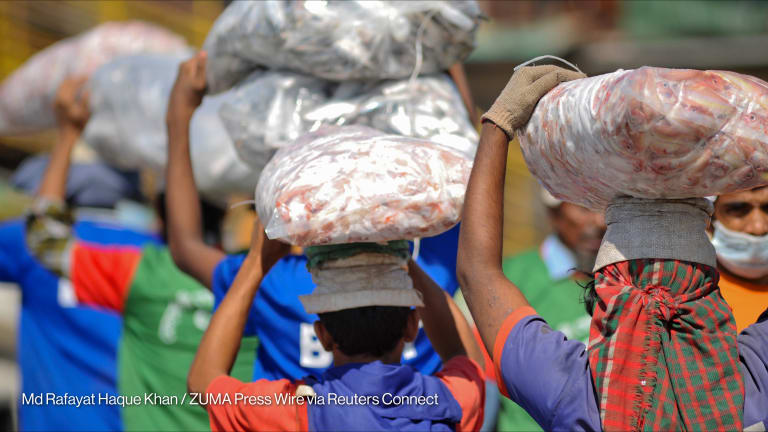
Happy Wednesday, Dish readers. Those of us in the Northern Hemisphere are in the depths of winter, which has brought blizzards, subzero temperatures, and school cancellations. But cold is also on the minds of those not currently digging their way out from under the snow: A warming world and growing population are highlighting the urgent need for cold-chain infrastructure to help curb food insecurity.
Cold chains are the networks of storage hubs and refrigerated transport that keep food cool as it moves from farm to consumer. In sub-Saharan Africa, up to 40% of food spoils before it reaches consumers, according to some estimates. Furthermore, food loss and waste is a massive environmental problem. The Food and Agriculture Organization estimates that if food loss and waste were a country, it would be the world’s “third-largest greenhouse gas emitter.” It’s a vicious cycle that propels more climate change.
A growing chorus of experts is calling for smarter, sustainable cold-chain solutions — such as off-grid renewable energy like solar power, as well as AI tools to predict and monitor energy use. “Can you imagine having 40% more food for a growing planet without having to do anything to increase the production?” Rusmir Musić, global cooling lead at the International Finance Corporation, the World Bank’s private-sector arm, tells Devex contributor Catherine Davison.
But scaling cold-chain infrastructure is expensive — and boosting conventional refrigeration would demand vast amounts of electricity. To make cold chains accessible to the 80% of sub-Saharan farms run by smallholders, innovative business models are essential. IFC, for its part, has been piloting cutting-edge technology such as “phase-change materials” and lithium-iron batteries to cool produce without the use of additional fuels in remote areas — with around two-thirds of its more than 100 pilot projects demonstrating cost savings of up to 85%.
Kenyan company SokoFresh offers solar-powered walk-in cold rooms in remote and hard-to-reach regions, ensuring affordable access to cooling even in places without stable power supplies. It uses a pay-as-you-store model and serves over 5,000 smallholder farmers each year across Kenya. In Nigeria, ColdHubs allows farmers to purchase cold storage and transportation as they need it, while using a remote monitoring system that offers real-time oversight of refrigerated trucks and cold facilities.
And while technology on its own can’t stop or reverse climate change, the investment opportunities are huge. Annual demand for sustainable cooling in developing economies is projected to double to $600 billion by 2050, according to analysis from IFC and the United Nations Environmental Programme — not just for food, but for homes, workplaces, and pharmaceutical products such as vaccines. But financial returns are often not immediate, and private-sector investors often view such investments in emerging markets as higher risk, Catherine writes. Sustainable cooling technology also requires higher up-front costs than older, less efficient cooling equipment.
A new research hub in Rwanda, the Africa Centre of Excellence for Sustainable Cooling and Cold Chain Systems, is focused on testing and scaling climate-friendly cooling technologies across the region. Meanwhile blended finance initiatives from multilateral development banks and country donors such as IFC, the African Development Bank, and the U.K. Department for Energy Security and Net Zero, are helping to de-risk innovation and boost private sector investment. The public sector is starting to take notice as well, with governments in Kenya and Rwanda realizing that cold-chain infrastructure is key to other goals such as reducing poverty and malnutrition.
Read: How a global cold-chain revolution can boost food security
From the COVID-19 archives: The cold-chain storage challenge
Background reading: Why food funding can't just focus on farming (Pro)
+ Not yet a Pro member? Start your 15-day free trial today to access all our expert analyses, insider reporting, funding data, exclusive events and briefings with sector leaders and influencers, and more. Check out some of the content exclusive to Pro readers.
With a little Alp from their friends
Speaking of the cold, the World Economic Forum concluded last week in snowy Davos, Switzerland. And each year, nutrition and food systems seem more prominent on the agenda.
A panel last week examined why progress on food security remains so slow, even as climate risks intensify. Across government, finance, and farming, speakers returned to the same tension: Food systems are under growing strain, but the burden of adapting still falls overwhelmingly on farmers, often without the tools or capital to solve anything. (Case in point: cold-chain infrastructure.)
Nigerian Vice President Kashim Shettima framed the issue as one of political and economic urgency, not just agriculture. “In Nigeria, we don’t look at food security purely as an agricultural issue,” he said. “It is a macroeconomic, a security, and governance issue.” With climate impacts accelerating, he argued that adaptation must move beyond small-scale experiments. “What I wish to happen in the next couple of months is to move climate adaptation from pilot to reality.”
That urgency was echoed by Brazilian farmer Ana Carolina Zimmermann, who described the mounting pressure on producers. “We cannot put all the risk on the farmer. We cannot put all the debts on the farmer,” she said. “Otherwise, farming is not going to be viable and we’re going to put food security down.” Others pointed to structural bottlenecks rather than technical ones. Yara International CEO Svein Tore Holsether argued that soil health and management remain deeply undervalued. “If you could only give two or three nutrients to people, what would happen to their health?” he asked. “Why do we think like that for plants?”
Álvaro Lario, president of the Rome-based International Fund for Agricultural Development, pointed to blended finance as one way to close the gap, citing an IFAD-backed program in East Africa that offers zero-interest loans to help small farmers adopt climate-smart practices. The goal, he said, is to cover the up-front costs many farmers cannot afford on their own, using public and development finance to de-risk investment through local banks. “Small-scale farmers don’t have the capital to transition on their own,” he said.
The takeaway: The tools to strengthen food systems already exist — but turning them into impact will depend on whether governments and financiers can move faster, scale proven models, and stop pushing risk down the chain.
Related: Davos Dispatch — a blizzard of development news in the Alps
Waste not
4 billion
—That’s the number of people worldwide who face water scarcity for at least one month every year, according to a new United Nations report that maps what it calls “global water bankruptcy.” It shows that many regions of the world are living beyond their hydrological means. Many societies are using water faster than it can be replenished in rivers and soils and overexploiting or destroying long-term water stores in aquifers and wetlands. Many human water systems are already past the point where they could be restored to former levels, the report says, and overuse and pollution must be addressed urgently.
Bringing home the bacon
Your next job?
Director, Food Is Medicine
Rockefeller Foundation
United States
While not everywhere is water-bankrupt, “enough critical systems around the world have crossed these thresholds,” says lead author Kaveh Madani, director of the UN University’s think tank on water. “These systems are interconnected through trade, migration, climate feedbacks, and geopolitical dependencies, so the global risk landscape is now fundamentally altered.”
The report’s other figures are sobering, too: 70% of the world’s major aquifers are in long-term decline, over 50% of large lakes are shrinking, 410 million hectares of natural wetlands have been erased, and nearly 75% of humanity lives in water-insecure regions. Drought costs the world $307 billion annually.
2026 is gearing up to be a major year for water, particularly in the lead-up to the U.N. Water Conference in the United Arab Emirates in December. Back in 2024, the U.N. launched its first systemwide strategy on water and sanitation, and it released its implementation plan last year. The December gathering is set to address water security in the final five years of the 2030 Sustainable Development Goals, along with what happens next. We’ve already seen water featuring more prominently in agendas this year, including at Davos; the Global Forum for Food and Agriculture in Berlin, Germany, earlier this month; and the African Union summit in two weeks.
Related: Amid water stress, experts want the world to get serious about irrigation
And don’t miss: Is the race to build AI in developing nations worth the water it takes?
Chew on this
As drought wipes out livestock, Kenyans fear “our children are next.” [France24]
Yemen’s farmers are struggling to survive amid plummeting foreign aid, water shortages, and a decade-long civil war [The Independent]
Can the U.S. actually withdraw from the World Health Organization without paying its debts? It’s an unprecedented and tricky question. [Devex Pro]
Ayenat Mersie contributed to this edition of Devex Dish.
About the author

Tania Karas@TaniaKaras
Tania Karas is a Senior Editor at Devex, where she edits coverage on global development and humanitarian aid in the Americas. Previously, she managed the digital team for The World, where she oversaw content production for the website, podcast, newsletter, and social media platforms. Tania also spent three years as a foreign correspondent in Greece, Turkey, and Lebanon, covering the Syrian refugee crisis and European politics. She started her career as a staff reporter for the New York Law Journal, covering immigration and access to justice.
Search for articles


Most Read
- 1
- 2
- 3
- 4
- 5