



Presented by RADIAN
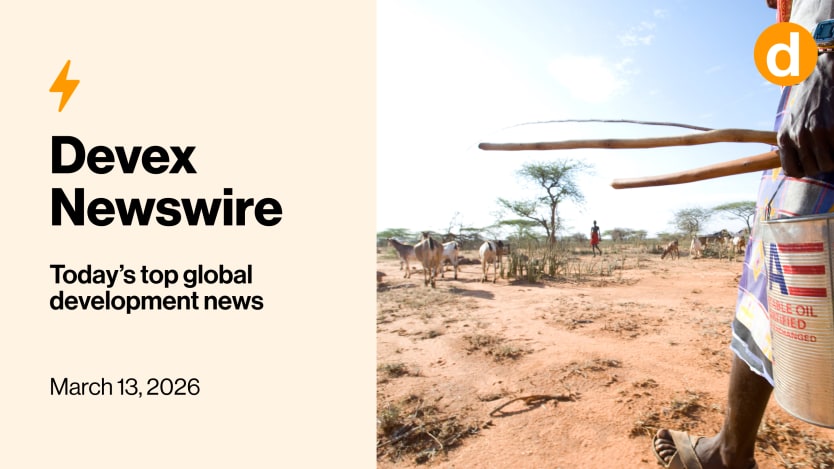
Kenya is confronting the fallout from shrinking foreign aid flows. The strain is showing up in drought-hit counties, livestock markets, and clinics. With debt already high, replacing the lost support will be difficult.
Also in today’s edition: The world needs to get serious about irrigation, Human Rights Watch’s perfect storm, and we’re at the Inter-American Development Bank annual meetings in Paraguay.
+ Want to learn how to create a portfolio career playbook for long-term consulting stability in the post-aid cuts job market? Join us on Monday for a Career Briefing to gain a practical framework for defining structure, pricing, and positioning. Register here.
This event is free for Devex Career Account members. If you aren’t one yet, you can upgrade at registration, or start a 15-day free trial now.
Aid gap bites
A year after the Trump administration’s stop-work orders upended the aid landscape, Kenya is getting the bitter taste of what happens when the foreign funding that long cushioned its social sectors starts drying up.
For years, external financing underpinned key services — especially health, writes Devex reporter Ayenat Mersie. Between 2020 and 2025, USAID committed roughly $2.5 billion to Kenya. Now, as those flows shrink, the strain is showing up in drought-hit counties, stretched clinics, and household budgets already under pressure.
“As we speak, about 40% of the population cannot afford $3 a day,” says Bernard Njiri, a public finance analyst at the Nairobi-based Institute of Public Finance.
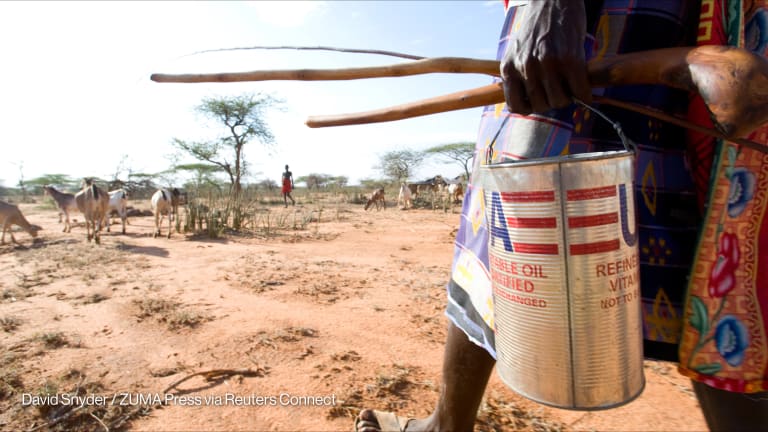
In northern counties such as Isiolo, the pressures are easy to see. Weak rains have shrunk pasture and crashed livestock prices. Programs that once helped buffer drought shocks — from irrigation canals to solarized pumps — stalled when USAID funding stopped.
“There was no adequate preparation in terms of withdrawal. No systems,” says Guyo Haro, an Isiolo-based governance and peacebuilding specialist who worked with USAID. “It’s so abrupt that you could see panic within the NGO staff and the local communities.”
The fallout is also reaching health clinics. A recent study found steep declines in essential reproductive health supplies in Isiolo’s public facilities.
“That now puts the country at risk of losing the gains that we have made so far in the fight against HIV and AIDS, in the fight against TB, in the fight against malaria,” Njiri says. “The human face behind it is that there are women and girls who now cannot use the method of choice,” Walter Obita, the Kenya country director at MSI Reproductive Choices, tells Ayenat.
Read: A year without USAID — in Kenya, the shock reaches herders and hospitals
Desk duty at the UN
Secretary-General António Guterres has ordered United Nations staff worldwide to return to the office at least four days a week, effectively ending the flexible work culture that emerged after the pandemic — and it’s not going down well.
The directive expands a rule already introduced at U.N. headquarters in New York and reflects what officials say is pressure from member states for more in-person engagement. But staff unions are pushing back hard, arguing the policy is out of touch, expensive, and even risky for staff in conflict zones.
“It’s all quite silly,” one U.N. staffer tells Senior Global Reporter Colum Lynch, noting many offices already lack space after downsizing. The staff union warned the shift could cost thousands per employee in additional office space — and urged leadership to scrap what it calls “performative measures” and focus instead on results.
Happy birthday, Mr. President
Ilan Goldfajn, the president of the Inter-American Development Bank is celebrating his 60th birthday with all his closest colleagues, development officials, private sector representatives and, of course, journalists, in Asunción, Paraguay, where my colleague Jesse Chase-Lubitz is attending the bank's annual meetings.
It’s been an eventful 24 hours for the birthday boy. Last night, he competed in a staff soccer game of international employees versus local employees on the field across from the conference venue. Jesse didn’t stay the whole time, but the score was 1-1 when she left halfway through.
Most of day one was focused on civil society consultations, something many have applauded about the bank. But these meetings are also chock-full of new announcements. On Wednesday, we reported that IDB Invest, the bank’s private sector arm, is poised to activate a $3.5 billion capital increase, with the U.S. submitting a legally binding commitment to participate. IDB is also preparing to expand its innovation and development efforts across Latin America and the Caribbean as it rolls out a new framework for IDB Lab, its innovation arm. Bank officials said the platform — which evolved from the former Multilateral Investment Fund — will operate with more than $1 billion in investment capital and grant resources over seven years, aimed at piloting new ideas and early-stage projects that can be scaled across the wider IDB system.
At a press briefing, Goldfajn signaled continued attention to vulnerable and fragile countries in the region. Officials pointed to ongoing programs in Haiti, including support for hospitals, school feeding programs, and job creation initiatives. While the bank said it is not currently engaged in Venezuela due to political constraints, officials indicated that internal studies and economic planning are underway to prepare for a potential future recovery scenario if conditions change.
Overall, the vibe is very positive, Jesse tells me — IDB seems to be a likeable bank that’s managing to push ahead with U.S. support despite fragmented multilateralism. Jesse will break it all down in a special wrap-up newsletter. Watch out for it in your inbox tomorrow.
ICYMI: IDB to unlock $3.5B increase with US signing on
When the wells run dry
The irrigation model that powered global food production for decades is hitting its limits. Groundwater depletion, rising demand, and increasingly erratic rainfall are forcing policymakers to rethink how agriculture uses water.
Agriculture already accounts for about 70% of global freshwater withdrawals, according to the World Bank. But experts say the future won’t rely on massive irrigation schemes so much as flexible, farmer-led approaches that blend rainfall, small pumps, and water harvesting, Jesse writes
“Future communities will require more than incremental improvements,” said Marianne Grosclaude, acting global director for the farming and agribusiness department at the World Bank, speaking at the Global Forum for Food and Agriculture in Berlin, Germany, earlier this year. “Agricultural water systems must become reliable, efficient, and responsive to local conditions, while staying within environmental limits.”
The stakes are high: Irrigated land makes up just 20% of cropland but produces about 40% of the world’s food — often by drawing down fragile groundwater reserves. In some regions, that dependence has become a “ticking bomb” for rural livelihoods, said Poolad Karimi, head of Global Water Informatics and senior irrigation specialist at the World Bank. “We know that after so many years, there will not be water to support the same way of doing irrigation in these areas,” he said.
The challenge now is finding the money — and the governance — to scale smarter water management. “Providing a pump without governance, finance, and long-term planning just creates a new problem,” said Stéphane Tromilin, a strategy director at Schneider Electric.
Read: Amid water stress, experts want the world to get serious about irrigation
+ On Wednesday, we’ll have Eileen Burke, global lead for water resources at the World Bank, and Jason Morrison, president of the Pacific Institute, unpack some of the biggest questions shaping the future of water investment and governance. Register now.
This event is exclusively for Devex Pro members. If you aren’t one yet, you can start your 15-day free trial today.
From the CSW floor
We’re reporting this week from the Commission on the Status of Women, or CSW, at the United Nations headquarters in New York — the world’s biggest gathering on gender equality — as governments and advocates grapple with a global rollback in women’s rights.
For this week’s edition of our podcast, This Week in Global Development, Colum joins colleagues Adva Saldinger and Elissa Miolene to break down the big debates that dominated the summit, the side conversations shaping what comes next, and the growing chatter around a possible merger of UN Women and United Nations Population Fund. We also check in on the early maneuvering in the race for the next U.N. secretary-general. Listen on Spotify, Apple Podcasts, Soundcloud, YouTube, or search “Devex” in your favorite podcast app.
Listen: Inside CSW — What is at stake for gender equality?
+ Elissa’s special newsletter detailing the major developments and talks at the halfway point of the CSW conference will be hitting your inbox later today.
HRW’s new chapter
It’s a homecoming — but not an easy one. Philippe Bolopion has returned to Human Rights Watch as executive director at what he calls “a perfect storm for the human rights movement,” warning that “the entire human rights project is in peril.”
The longtime insider took over as executive director in November after a rocky leadership transition. A former U.N. journalist who later spent years shaping HRW’s advocacy, Bolopion calls himself “very old school Human Rights Watch,” anchored in rigorous fact-finding.
But his start hasn’t been smooth, writes Amy Fallon for Devex. Two staffers who make up HRW’s Israel and Palestine team quit after the group paused a report on Palestinian refugees’ right of return. “We didn't block it,” Bolopion says. “We put it on pause to make sure that we could strengthen the findings and make sure that it would be as compelling as it could be.”
Now he says the task is clear: focus the organization’s roughly $100 million budget on crises and hold powerful governments — including the U.S., China, and Russia — to account.
Even so, he insists the movement still has momentum. “I don’t think you can do this job if you don't have a deep faith in the ability to shape the future,” he says. “The idea of dignity, human rights, it's powerful, it’s enduring, even in times like this.”
Read: Human Rights Watch’s new chief returns to steady ship in a ‘perfect storm’
In other news
Ghana is set to submit a U.N. resolution calling for reparations for transatlantic slavery, with broad support from the African Union and Caribbean Community nations. [Reuters]
The U.K.’s flagship Global Health Workforce Programme, which provided development and training support for health care workers across six African nations, will close at the end of the month. [The Guardian]
The U.N. has found no signs of meaningful human rights reform in Venezuela, warning that repression is mutating rather than ending two months after the U.S. removal of President Nicolás Maduro. [Al Jazeera]
The U.K.’s aid watchdog released a report finding that the country’s aid spending has often been too focused on hitting spending targets rather than delivering specific objectives. [ICAI]
Sign up to Newswire for an inside look at the biggest stories in global development.
About the author

Helen Murphy
Helen is an award-winning journalist and Senior Editor at Devex, where she edits coverage on global development in the Americas. Based in Colombia, she previously covered war, politics, financial markets, and general news for Reuters, where she headed the bureau, and for Bloomberg in Colombia and Argentina, where she witnessed the financial meltdown. She started her career in London as a reporter for Euromoney Publications before moving to Hong Kong to work for a daily newspaper.
Search for articles



Most Read
- 1
- 2
- 3
- 4
- 5